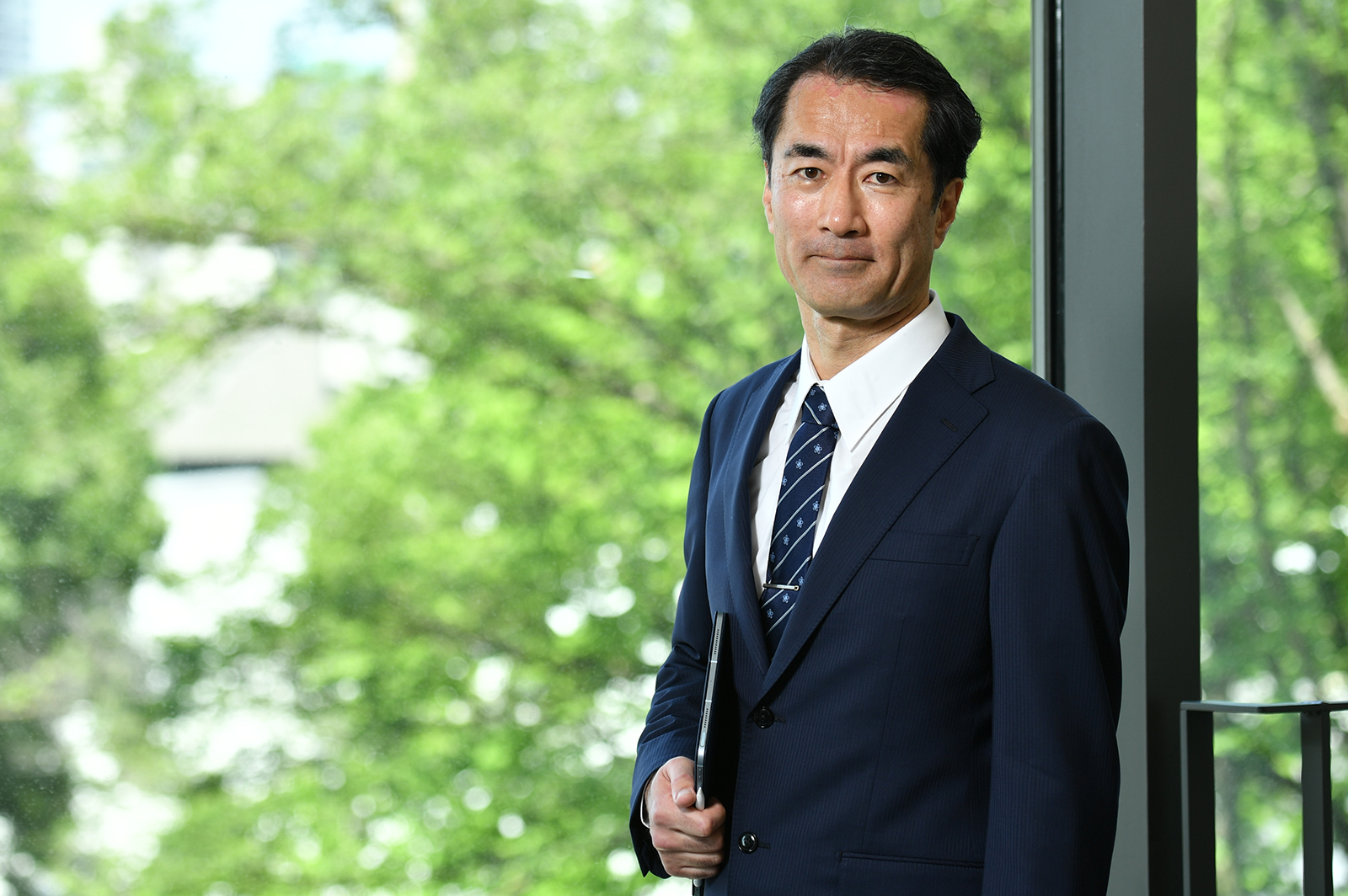
 Interview
- Profile
- Graduated from Hitotsubashi University Graduate School of Economics with a master’s degree in 1989. Graduated from Iowa State University with a PhD (Statistics) in 1994 and received the Research Excellence Award. Became Lecturer in 1995 and Associate Professor in 1998 at Hiroshima University Faculty of Economics. Became Professor at Gakushuin University Faculty of Economics in September 2000.

Exploring the Depths of Data: The Potential of Statistics
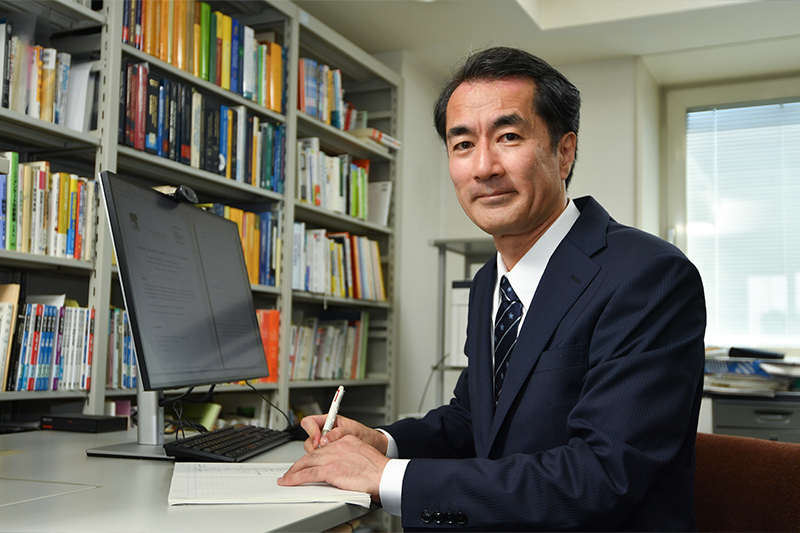
From extreme value statistics to forecasting: The vast world of statistics
Professor Jun-ichiro Fukuchi is a researcher specialising in statistics. Statistics is a discipline that encompasses the entirety of data processes, from acquisition and analysis to interpretation and prediction. In recent years, statistics has garnered attention as a core field within data science, gaining further prominence with the advent of big data and AI.
As a statistics expert, Professor Fukuchi’s research topics cover a wide range of interests: extreme value statistics, ranking and selection of populations and resampling methods. At first glance, these may appear to be diverse fields, but all are deeply rooted in the very essence of statistics: extracting useful information from data.
“Extreme value statistics is a field that analyses phenomena that take extreme values,” explains Professor Fukuchi. While statistics mostly analyses average trends, extreme value statistics focuses on the tail of the distribution : in other words, the most extreme values. This approach is based on the idea that extreme values contain important information on the tail of the distribution. It can be applied in a variety of fields, such as assessing the risk of extreme weather associated with climate change, or taking measures against events that happen rarely but whose impact — if they do occur — could be catastrophic, such as extremely sudden fluctuations in financial markets.
“We analyse rare events and their impacts, such as rivers that flood to ten metres about once in 100 years, or regions that experience extreme heat in excess of 45 degrees Celsius only once in a few decades. While little data on extremely rare events is available, we can analyse them by making weak assumptions on the tail of the probability distribution.”
The second theme, selection of populations, is a method for selecting from multiple populations those that have a certain effect. Professor Fukuchi explains the application of this method as follows:
“For example, it can be used in situations where the effects of multiple new drugs are measured and the most effective one is selected, or all those that are more effective than existing drugs are selected. It can also be applied where experiments are possible, to compare the effects of policies and select the optimal policy with a certain confidence level.”
“Currently, I am conducting research that combines extreme value statistics and population selection. One application of this method is to select locations from multiple locations that are at high risk of large-scale natural disasters.”
The third theme is resampling methods. A representative example of this is the bootstrap method, which approximates the distribution of a statistic by randomly sampling from the collected data repeatedly. It is not a standalone technique, but rather a versatile method that is useful when combined with other statistical methods.
“Resampling methods are useful for improving the accuracy of various statistical methods. They are particularly effective when the amount of data is small, or the theoretical distribution is unknown.”
As we’ve seen, there is a wide range of analytical and predictive methods in statistics, and Professor Fukuchi’s own research has evolved alongside this changing discipline.
“Developments in computers have made it possible to perform large-scale calculations that were hitherto unfeasible. This has led to the emergence of new methods, like machine learning. Additionally, we are now able to handle a wide variety of data, including images, audio, and speech patterns in various languages. This ability to perform massive calculations that were not possible when calculating manually or when using older computers is spurring the development of new methods. Machine learning can be considered an evolution of traditional statistics, but the key difference is that its primary purpose is to continuously make predictions based on new data.”
This evolution is considerably expanding the scope of statistical applications. For example, it is now possible to apply methods to previously unimaginable fields, such as in medical diagnosis using image recognition technology and in sentiment analysis using processing of human speech patterns.
Professor Fukuchi points out, however, that the evolution of his own field of research has not necessarily been driven by the development of computers. His exploration has consistently focused on the methodological aspects of statistics, developing new methods and elucidating their properties.
“Theoretical research provides the foundational thinking behind new application fields. It can also clarify the limitations of existing methods and point a way toward improvements. I find research most enjoyable when considering new statistical methods or approaches to new problems.”
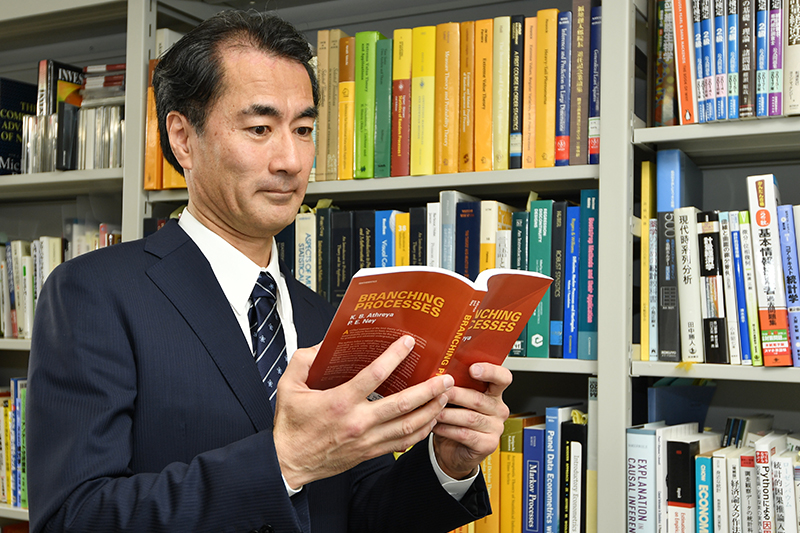
From empirical to theoretical thinking: walking the statistics pathway
Professor Fukuchi’s interest in statistics dates back to his undergraduate days. As a student in the Faculty of Economics at Gakushuin University, he was enrolled in seminars given by the late Professor Takuji Shimano and studied econometrics under Professor Mitsugu Nakamura of the University of Tokyo and the late Professor Kurotake Arai.
“While studying economics, I became interested in the analysis of data, such as exchange rates and trade balances,” Professor Fukuchi recalls. “Macroeconomics, which deals with data, involves drawing empirical conclusions through statistical analysis. Today, this is called empirical analysis. I thought that, by acquiring the technical knowledge to handle data using statistical methods, I could be of use in some way. At that time, I remember having a lot of fun working with Hajime Ito (currently a professor at Japan Health Science College) on assignments such as estimation of the production function for a class taught by Professor Arai, who had just arrived at Gakushuin University.”
Economics has both theoretical and empirical aspects, but Professor Fukuchi says he was particularly drawn to empirical analysis, which draws concrete conclusions based on data. Furthermore, his developed interest in mathematics at the time, he felt an affinity with statistics, which has a mathematical aspect to it.
“One of the attractions of statistics is its versatility,” Professor Fukuchi says. “It’s a methodology that’s useful not only in economics, but also in a variety of other fields, including medicine, psychology and engineering. I think many statisticians believe that acquiring expertise in this powerful discipline and methodology will allow themselves to be useful to others.”
After graduating from Gakushuin University, Professor Fukuchi went on to study statistics in more depth at the Hitotsubashi University Graduate School of Economics, where he began to assiduously study statistical theory.
“Once I entered graduate school, I immersed myself in the study of statistics,” Professor Fukuchi says. “My supervisor at that time was Professor Takeaki Kariya, a theoretical researcher who taught me statistical theory thoroughly, starting from the basics. In that period, systematic education in statistics was in its early stages at Hitotsubashi University’s graduate school, so I was incredibly fortunate to be present as it developed. While I was there, I read a joint paper on prediction by Professor Kariya and the late Professor Yasuyuki Toyooka, and it sparked my interest in the subject. As a Japanese saying goes, ‘A three-year-old’s soul lasts until a hundred,’ and I feel that an interest you develop when you’re young can have a lasting impact.”
Through his graduate studies, Professor Fukuchi became increasingly fascinated by the depths of statistics. And his interest in prediction, in particular, remains to this day the foundation of his research work.
Afterwards, Professor Fukuchi went on to attend graduate school at Iowa State University with the aim of conducting research into statistics. Professor Fukuchi explains his reasons for choosing the United States:
“I decided to go to the United States upon the recommendation of Professor Kariya, to study at a graduate school specialising in statistics. Indeed, the Department of Statistics at Iowa State University provided an environment where you could study statistics itself, regardless of its application. Seeing researchers and students from various countries in competition with each other was a truly valuable experience.”
“At Iowa State University, I studied under the guidance of the late Professor Krishna B. Athreya and Professor Soumendra N. Lahiri, conducting research on the bootstrap method and other topics. Professor Athreya was a probability theory expert and a researcher with many achievements in fields such as branching processes, Markov processes, and the bootstrap method. When I showed Professor Athreya new results or conjectures - even if the results were minimal - he would praise them, calling them ‘Beautiful!’ This encouraged me to continue my research. It was around this time that I first learned about extreme value theory and presented at an international conference. The research I conducted during this time marked the beginning of my career as a researcher.”
After receiving his PhD from Iowa State University, Professor Fukuchi returned to Japan in 1995 to work as a lecturer at the Faculty of Economics at Hiroshima University. Then, in 2000, he took up a position at Gakushuin University.
“At Hiroshima University, Professor Koichi Maekawa played a key role in leading econometrics researchers, ensuring they benefitted from a good research environment. Both Hiroshima University and Gakushuin University offer focused research environments. I was fortunate to be able to work at both universities,” Professor Fukuchi says. “At Gakushuin, there is ample available time and funding for research. And there’s also an atmosphere of mutual respect among researchers.”
In this favourable environment, Professor Fukuchi not only furthers his own research but also passionately nurtures the next generation of statistical researchers.
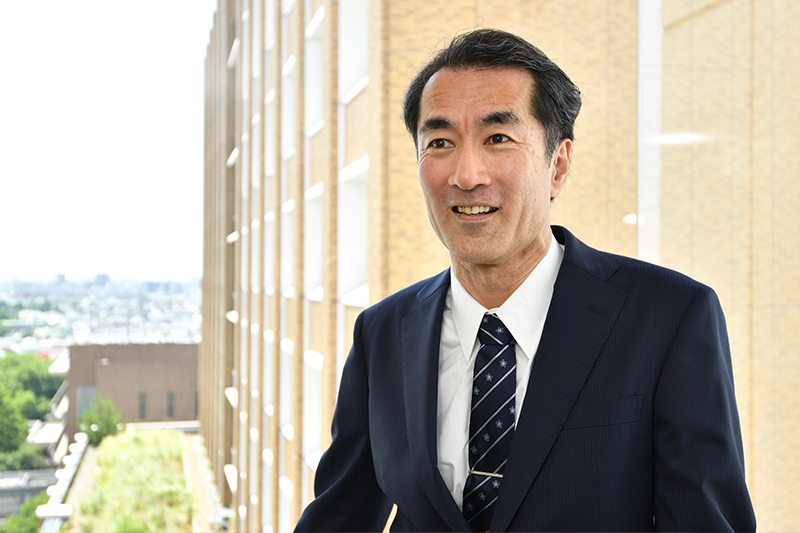
Gakushuin’s research environment offers an excellent balance of theory and application.
Professor Fukuchi, who has been conducting research at Gakushuin University for over 20 years, points out that one of the distinctive features of the Graduate School of Economics is its tradition of analysing and discussing the real economy.
“Gakushuin’s Faculty of Economics and Graduate School of Economics has long been home to many researchers who conduct data-based economics research (in the broadest sense). Another distinctive feature is the well-balanced study of the four fields of microeconomics, macroeconomics, econometrics and economic history.”
In particular, the school has a robust research and education system in the fields of statistics and econometrics. “We have more than three faculty members researching statistics and econometrics, which is quite a lot for a graduate school of this size. Furthermore, many faculty members conduct research using econometric analysis and data-based causal analysis.”
This environment is a great advantage for students, who can not only learn statistics and econometrics from both theoretical and practical perspectives, but can also be exposed to case studies in a variety of fields. Professor Fukuchi further explains the appeal of Gakushuin University’s graduate school:
“Our school also covers the latest statistical methods and machine learning technologies. For example, in my class, ‘Seminar on Data Science’, we cover prediction methods using statistical learning (machine learning), such as regression, decision trees, boosting and conformal prediction. I think this content is extremely useful for anyone who wants to create prediction systems that suit their own purposes.’
Professor Fukuchi also emphasizes the unique features of Gakushuin University’s graduate school. “Because our graduate school is relatively small, there is close communication between the faculty and students. We are able to provide instruction tailored to the needs of each student. We also have an environment that makes it easy to conduct research that combines economic theory with statistical methods.”
Another distinctive feature of Gakushuin is its proactive approach to accepting working graduate students.
“It’s entirely possible to master the theories and techniques of statistics and empirical analysis in two years,” says Professor Fukuchi. “I think the option of completing a master’s programme with a special research paper that is shorter than a master’s thesis is particularly appealing to working adults.”
“Another strength of our researchers is that we can provide advice not only on well-known and well-established statistical methods, but also on the very latest methods. If there are challenges you are facing in the business world or projects you would like to work on in the future, I believe that researchers can discuss these issues with working professionals and find a solution.’
Professor Fukuchi concluded by saying:
“As our data-driven society advances, statistics and statistical learning methods are evolving at an astonishing pace, and their importance is increasing. Gakushuin University Graduate School aims to provide a learning environment that balances theory and application, and to contribute to the development of the next generation of data scientists. If you are interested in statistics or statistical learning, please come and join us.”
| Date of interview: | 4 June 2024 |
| Interviewer/writer: | Hiroyuki Tezuka |
Positions and affiliations reflect information at the time of the interview.
Date of interview: 4 June 2024 / Interviewer/writer: Hiroyuki Tezuka
Positions and affiliations reflect information at the time of the interview.