 Interview
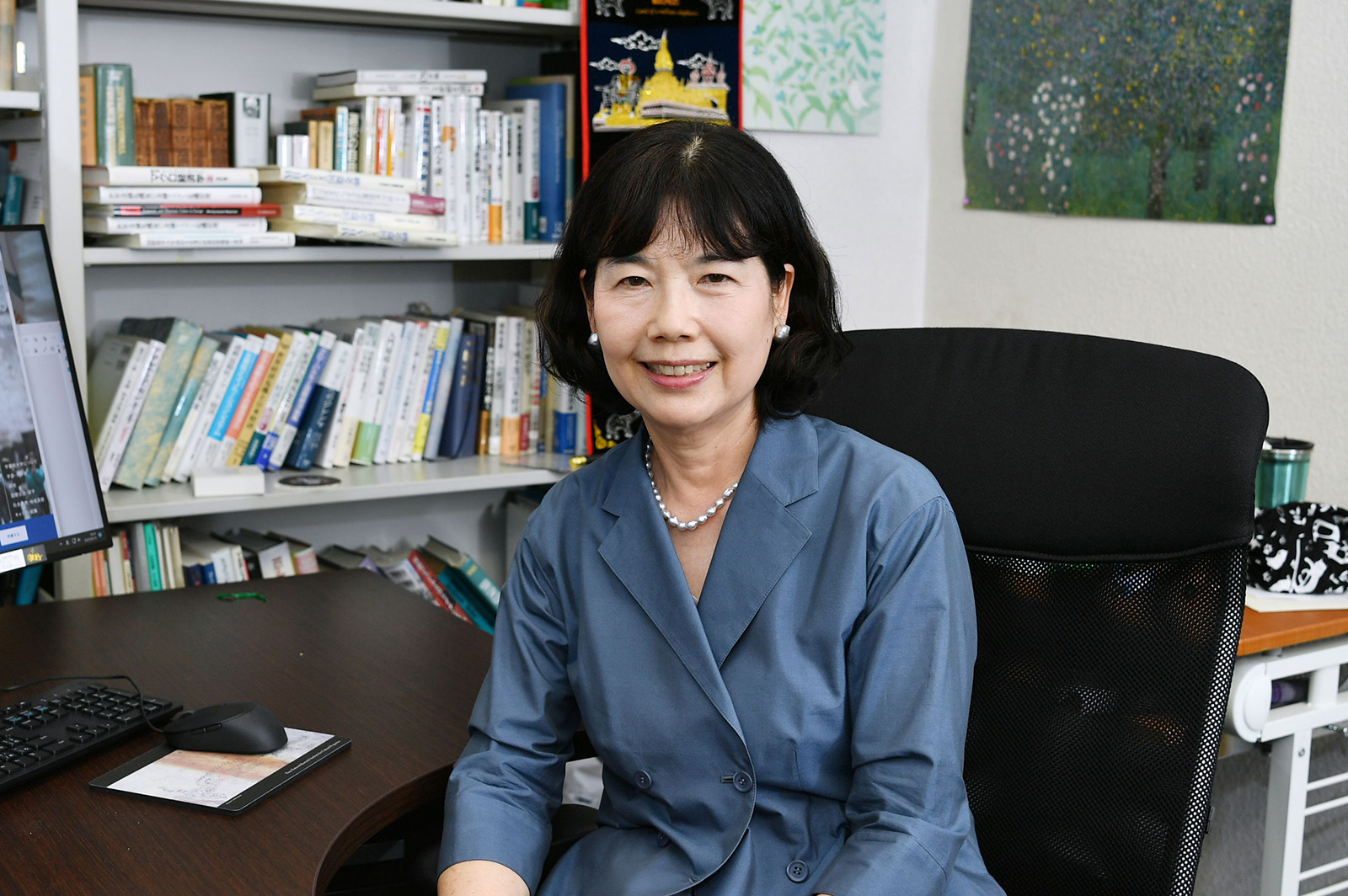
Professor Junko Shimizu
- Research Fields
- International Finance, Foreign Exchange
- Profile
- Graduated from Hitotsubashi University Faculty of Economics in 1982. Joined Chase Manhattan Bank (now JPMorgan Chase) in 1982, and subsequently worked at the Industrial Bank of Japan, Bank of America and Morgan Stanley. Completed doctoral studies at Hitotsubashi University Graduate School of Commerce in 2004. Served as assistant professor at Hitotsubashi University Graduate School of Commerce, as associate professor at Meikai University School of Economics, and as associate professor at Senshu University School of Commerce, before assuming current position in 2012.

The Future of International Finance: A Fusion of Practice and Academia
A career change taught me the joy of learning
“When I returned to graduate school after leaving the workforce, it was the first time I realised: ‘Study is interesting’.”
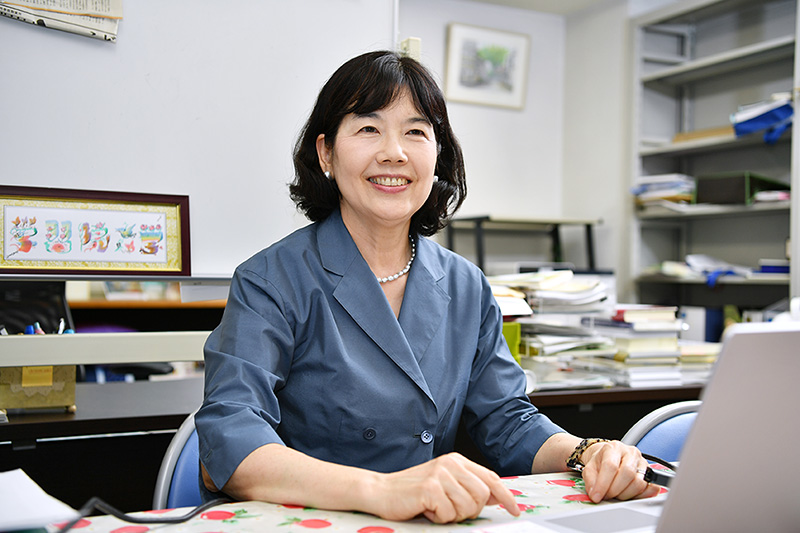
Professor Junko Shimizu reflects on entering graduate school at 40, having given up work to raise her children. After graduating from Hitotsubashi University’s Faculty of Economics, she joined Chase Manhattan Bank (now JPMorgan Chase). Working in Japan and in London, she immersed herself in the world of global markets, moving between the Industrial Bank of Japan, Bank of America, and Morgan Stanley.
In her twenties and thirties, Professor Shimizu devoted herself to the world of foreign exchange. But then came a major turning point in her career. It was brought on by a significant life event that forces many women to make career choices: childbirth. Working in London at the time, Professor Shimizu initially sought a way to juggle her professional life with raising a child, taking advantage of the support systems and services available to her. However, after returning to Japan and having her second child, she decided to step back from her professional life and focus on her family.
“In London, I had the option of hiring a nanny to help with childcare. But, at that time, childcare services in Japan were not as common as those available in London. I relied on my parents for a while, but that quickly became too much, so I decided to leave work and focus on raising my children.”
From the front lines of the global economy to bringing up children in an ordinary household: it’s no exaggeration to say that Professor Shimizu’s career was completely upended. But then she chose yet another path.
“I thought I still had a long way to go in life, so I started wondering what I should do next. It occurred to me that I should invest some of the money I’d been saving up. I wanted to study something that would connect with my previous work, so I made the decision to go to graduate school.”
And, so, Professor Shimizu chose the Graduate School of Commerce at her alma mater, Hitotsubashi University. Initially, she opted for graduate school to study while raising her children, but she quickly became absorbed in academia.
“Applying theory to certain stories I heard at work gradually helped clarify for me why certain phenomena occurred. As I learned about the various causal relationships behind events that I had previously taken for granted, the work I had been doing began to make sense. I entered graduate school at the age of 40, but never imagined that studying would become so enjoyable for me.”
Having discovered the joy of learning, Professor Shimizu devoted herself to her research. And, before she knew it, she had completed her doctoral studies at Hitotsubashi University’s Graduate School of Commerce and Management. She was then appointed by the school as an assistant professor. “I never expected to continue studying for this long, and I certainly never dreamed I would become a university professor at 47,” Professor Shimizu explains. As a female researcher, and with the support of the government’s Basic Plan for Gender Equality, Professor Shimizu was also invited to sit on various advisory councils.
“At the time, there were very few women studying economics, so even though I was just starting out, I was asked to join. Nowadays, gender is discussed quite actively, but back then I was very grateful to have been given a position such as a council member, which was a way of helping women advance in society. I think it was an opportunity to gain experience and learn things that I could not have acquired elsewhere, and to allow me to see how the government makes decisions.”
Professor Shimizu rode the trend of her times and seized her opportunity. She reflects on that period as follows:
“The opportunity to participate in government advisory councils has allowed me to make many lifelong connections. I probably wouldn’t have had the chance to sit alongside renowned professors if I’d continued working at a bank.
“In recent years, as a researcher, I’ve had more opportunities to reunite with people from companies I originally met when I was a banker. At the time, we were all employees, but when we got back together after a long period apart, I sometimes discovered that one of them had now become a finance director. I believe the reason I’m able to work as a researcher today is because I didn't let go of anything from my career.”
Understanding foreign exchange and global trends
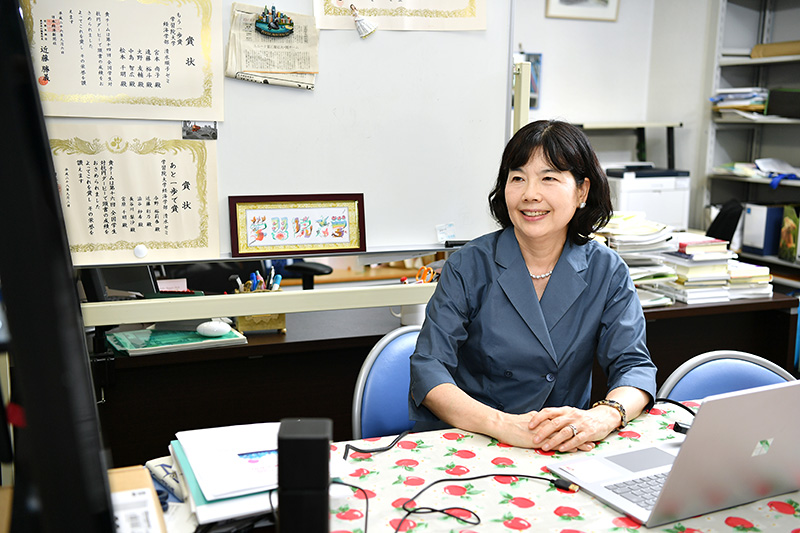
After building her career as a foreign exchange professional at domestic and international banks, Professor Shimizu continues to focus her research on ‘international finance’ and ‘foreign exchange’.
“Japan is one of the developed countries with the most volatile exchange rates. Domestic companies’ business activities are affected daily by exchange rates. In my laboratory, we primarily conduct research from a practical perspective, focusing on how exchange rate fluctuations affect Japanese companies and the economy, and what is needed to mitigate that impact.”
Professor Shimizu’s area of expertise is the historically weak yen, which has been making headlines in recent years. Around December 2014, the economic policy ‘Abenomics’ - launched by the administration of Shinzo Abe - caused the currency to plummet from 80 to 120 yen. At the time, the yen’s continued depreciation was reported in the news on an almost daily basis, but in her book A Bad Weak Yen, a Good Weak Yen, Professor Shimizu warns that the current yen’s depreciation is a “bad yen depreciation”.
“In 2013, when Abenomics led to a significant depreciation of the yen, crude oil prices were also on a downward trend. Consequently, gasoline prices did not soar, and no reports emerged that provoked concern over the weak yen.”
However, this time, due in part to the impact of the Russia-Ukraine crisis, geopolitical risks have led to a surge in crude oil prices. To make matters worse, the yen’s depreciation has led to a period in which gasoline prices are as high as 200 yen per litre. Furthermore, electricity prices are rising in tandem with crude oil prices, leading to price hikes across the country.
Professor Shimizu also points out that a weak yen leads to higher prices because most intercompany transactions are conducted in dollars. If the invoice currency for trade is set in yen, price increases due to a weak yen will not occur in the short term. However, with the current negative interest rate, the yen lacks international competitiveness, and few trading partners are willing to accept it.
“Whether a trading partner will accept yen-invoicing negotiations depends on the company’s negotiating power. However, if the other party is not interested in holding yen, no matter how much they negotiate, they will tend to prefer the dollar, which has a higher interest rate.
“Whether the yen is chosen as an invoice currency is also greatly influenced by a country’s monetary policy. If the current monetary easing policy continues, the number of people who are reluctant to accept yen may grow.”
Another reason for the slowdown in yen-invoiced transactions is the rise of the Chinese yuan. China’s rapid economic growth has made it so influential that it is now one of Japan’s largest trading partners. As China has become more powerful as a producer and exporter, the need to standardise on the dollar has diminished.
“Nowadays, products made in China are no longer exported to the United States. Instead, products for the U.S. market are made by subsidiaries in the United States, and products made in China are increasingly sold within China or are exported to neighbouring Asian countries. As a result, local Chinese subsidiaries no longer need to use dollars and are insisting on using yuan.”
Customs data from various countries shows that a number of emerging market currencies, including the baht, ruble, and rupee, are being used in addition to the RMB. Now that the dollar has gone from being the dominant invoice currency and has been replaced by a variety of currencies, including the RMB, how can the yen maintain its status? As a researcher, Professor Shimizu is intrigued by these changes:
“The dollar remains the dominant invoice currency. There was a time when the RMB was considered unusable as an international currency, but now we’re seeing gradual changes. As an expert on trade invoice currencies, I think we're living in truly interesting times.”
An opportunity for renewed learning and to open up new pathways in life
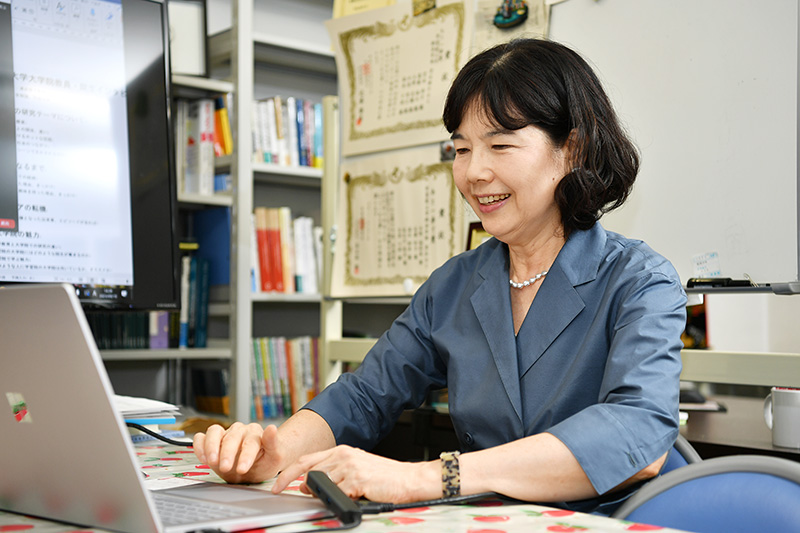
The world of international finance is constantly changing. Because this academic field is closely connected to the work she herself has been conducting, Professor Shimizu emphasises the importance of “relearning for working adults”.
“I didn’t realise it until I graduated from university, but studying is truly enjoyable. It was precisely because I entered graduate school at the age of 40, after working at a bank, that I experienced a sense of connection between work and academia.
“Tuition fees are soaring these days, so it’s a good idea to enter the workforce and then use the money you’ve earned to study. I would recommend graduate school to all sorts of people, from those looking to reskill while working at a company to those who want to relearn after their retirement.”
In fact, two doctoral students in Professor Shimizu’s laboratory are conducting their research while still working for the Ministry of Finance. How do these researchers balance their work as bureaucrats with their lives as graduate students? According to Professor Shimizu, the answer lies in the unique characteristics of Gakushuin University’s laboratory.
“Gakushuin University’s graduate school doesn’t have a large student population. This makes it easier to create a flexible environment, such as providing thesis supervision online or at night. If you work near Mejiro Station, where Gakushuin University is located, you can probably take a half-day off to attend lectures. Recently, more and more companies are encouraging employee reskilling, so I hope you will take advantage of this system and choose to study at a graduate school.”
Another reason Professor Shimizu cites for Gakushuin's suitability for working adults seeking reskilling is its “close relationships with high-level researchers”.
“Gakushuin University has many highly talented researchers, and I believe the Graduate School of Economics offers one of the best learning environments in the country. Everyone, including young researchers, works constantly on their own research topics, so I believe there is much to learn as a graduate student.
“Also, because the graduate school is not large, relationships between professors and students naturally become close. Not only can students benefit from guidance from their supervisors, but multiple professors also generously allocate time to mentor students to help them fulfil their aspirations. Simply put, I think we are a ‘caring graduate school’.”
In conclusion, Professor Shimizu draws on her own experience to once again encourage working adults to re-learn:
“I believe it is precisely those who have already entered the workforce who can truly appreciate the value of studying. Just as I discovered the joy of learning at the age of 40, I would like many working adults to know they also have the option to pursue graduate school.
“Whether it’s to acquire knowledge that will be useful in the workplace or to have another attempt at studying a subject you previously gave up on, I encourage you to seize the opportunity Gakushuin Graduate School offers and open up new pathways in life that will help reap rewards for decades to come.”
| Date of interview: | 19 September 2023 |
| Interviewer/writer: | Hiroyuki Tezuka |
Positions and affiliations reflect information at the time of the interview.
Date of interview: 19 September 2023 / Interviewer/writer: Hiroyuki Tezuka
Positions and affiliations reflect information at the time of the interview.