 Interview
- Profile
- Graduated from Kyoto University Faculty of Economics in 1984 and joined the Economic Planning Agency (now the Cabinet Office). Completed master's degree at Northwestern University in 1990. Became associate professor at Nagoya City University Faculty of Economics in 1999. Became associate professor at Gakushuin University Faculty of Economics in 2003 and professor in 2004. Received PhD in Economics from Hitotsubashi University in 2009. Served as visiting scholar at Yale University and senior research fellow at the Ministry of Finance’s Policy Research Institute. Returned to Gakushuin University Faculty of Economics in 2013.

Understanding the Mechanisms that Drive Economy and Finance through both Theory and Practice
Questioning the essence of finance in an ever-changing society
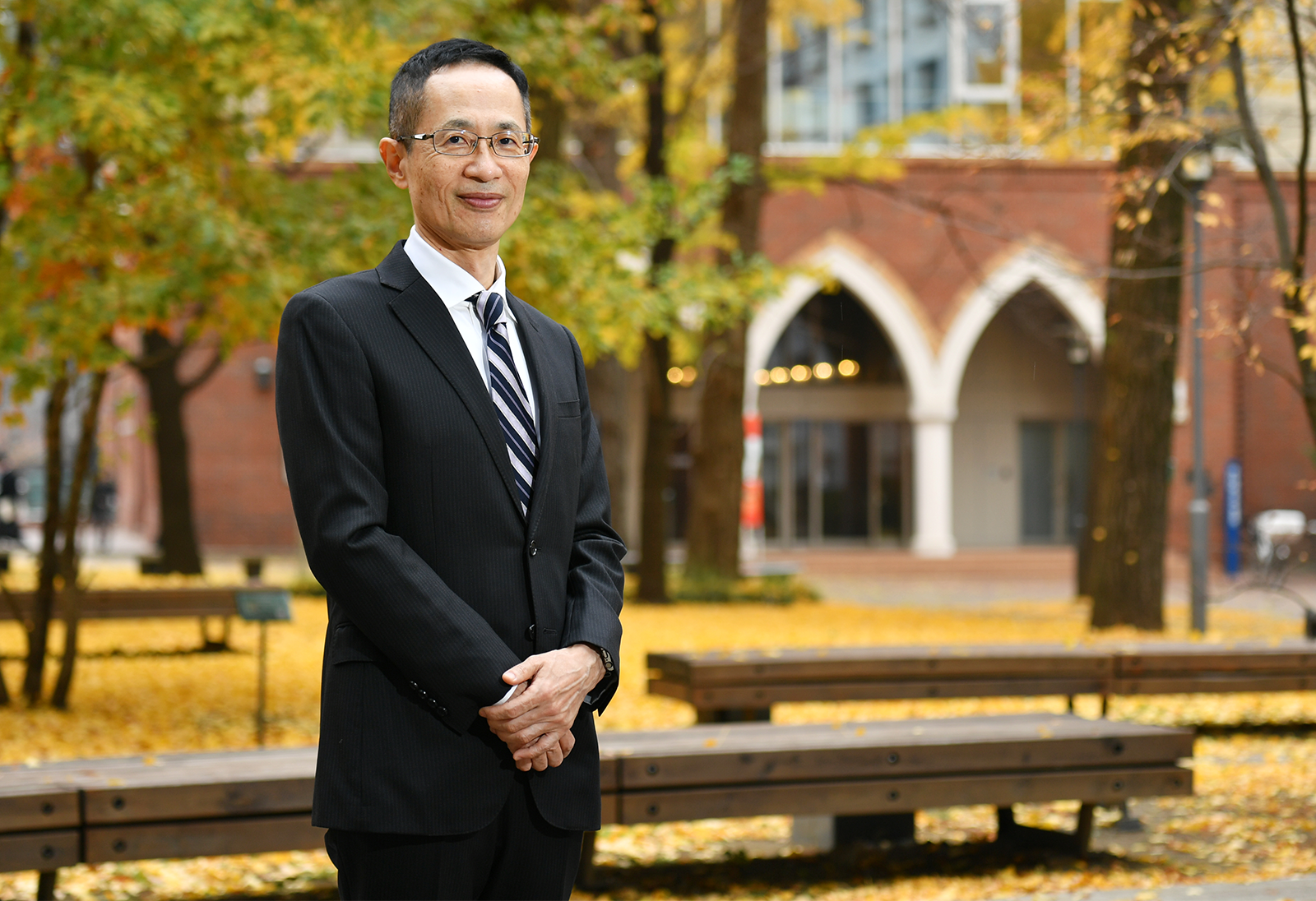
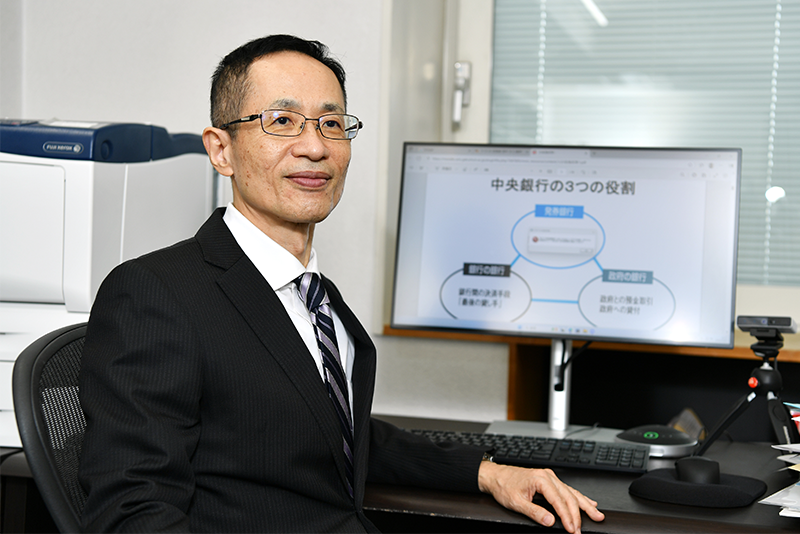
Our society is constantly facing unexpected shocks, such as the Great East Japan Earthquake, the COVID-19 pandemic and the recent rapid expansion of generative AI. When such major changes occur, how do financial systems, such as banks and stock markets, respond? What ripple effects do they have on corporate production activities, household consumption and the aggregate economy? Professor Kaoru Hosono, a specialist in macroeconomics and finance, focuses on the intersection between finance and the real economy, conducting empirical analysis using data.
The world of finance has changed dramatically as technology has advanced, from the physical currency of the past to modern-day electronic payment systems like PayPay, and even blockchain-based stablecoins. However, in his classes, Professor Hosono emphasizes what remains unchanged rather than what changes.
“The emergence of new technologies has dramatically changed the cost and speed of financial transactions. However, the essential functions of money, such as exchanging and storing value, have remained unchanged since the days of stone coins and wheat. The key to understanding the turbulent modern economy is to discern this universality and transformation.”
The professor places particular emphasis on the role of financial functions in times of crisis. In a joint research project on the Great East Japan Earthquake conducted by Professor Hosono and his colleagues, a detailed analysis of data from companies and banks in affected areas revealed a notable fact: that the damage caused by the earthquake not only resulted in a decline in the asset value of the affected companies themselves, but also spread secondary damage via the weakening of the functions of regional financial institutions.
“Our analysis revealed that the deterioration in the business of affected banks also put a restraint on the fundraising ability and recovery of client companies that were not directly affected. This ‘negative spillover effect of damage to banks was as severe as the impact of the damage on the companies themselves. Therefore, from an economic perspective, it makes sense for the government to support financial institutions in times of crisis as it also underpins the economic recovery of the entire affected area.”
In addition to examining past crises, the professor also focuses his attention on future changes. Currently, sources of economic activity are shifting from tangible assets, such as factories and equipment, to intangible assets, such as software, research and development, brands and the ability to harness AI. The United States is ahead of the curve, and distortions such as the concentration of wealth in large IT companies and widening inequality are emerging, but Japan has yet to fully ride the wave of change. Professor Hosono points out that this time lag is precisely the challenge Japan faces.
“It’s often said that what happens in the United States will come to Japan later, and Japan will eventually face similar challenges. A particularly problematic issue is that intangible assets, unlike land and buildings, are difficult to assess as collateral. How should the financial system supply funds in an economy centred on intangible assets? This is an urgent issue that Japanese financial institutions and policymakers must address without delay.”
Through this research, the professor is teaching his students the essential literacy of the academic field of financial theory. And it’s not just about asset management techniques.
“While it’s good to be interested in investing, the essence of what you should learn at graduate school is to understand the principle that ‘you must take risks to obtain returns’. Which risks lead to returns and which don’t? The ability to discern this mechanism is an essential skill not only for researchers, but also for corporate financial officers and those responsible for managing the economy of the entire country.”
From practical experience to cutting-edge theory
Professor Hosono’s research style delves acutely into real-world social issues and was shaped by his unique career. After graduating from Kyoto University’s Faculty of Economics, he chose not to join a research lab but rather to become a civil servant. He joined the then Economic Planning Agency (now the Cabinet Office), positioning himself at the forefront of economic policy.
The origins of this decision date back to Professor Hosono’s high school days. As a young man, he had an intense desire to comprehend how the society functions and to improve it. He believed he needed to understand what lay at the foundation of it all - ‘economy’ - and so aspired to enter the Faculty of Economics. After enrolling at university, he reveals he was unable to focus fully on his studies for some time. But a turning point came in his third year.
“My friend Masahiko Egami (currently Vice President of Kyoto University) brought me a specialised economics book and said, ‘This looks interesting, why don’t we read it together?’ As we both read through the book, which was quite different from the textbook we were using in class, I became fascinated by the depth and logical appeal of the academic field of economics.”
Although Professor Hosono aspired to become a researcher, he ultimately chose a practical career path because he wanted to see the real world firsthand before pursuing theoretical work.
“At the time, the Economic Planning Agency was the government body responsible for overall coordination of economic policy. The hands-on experience I gained there of producing statistics and of the policy-making process is still of great use in my ongoing research. Having knowledge of the administrative workplace allows me to conduct down-to-earth analysis. For example, when implementing evidence-based policymaking (EBPM), which has become increasingly important in recent years, it’s essential to have firsthand knowledge of how policies are created and implemented.”
He then took advantage of an internal funding programme to study at Northwestern University in the United States, where he witnessed a paradigm shift in economics. From the late 1980s to the early 1990s, the United States was seeing the birth of a new trend in modern economics, one in which microeconomics (the principles of behaviour among individuals and companies) was integrated into macroeconomics (the movement of an entire economy), two disciplines which had previously been regarded as separate.
“To predict the effects of economic policy, we must incorporate into the model how each individual thinks and behaves. It was really stimulating to witness the first stirrings of this new theory and to receive direct guidance from Nobel Prize-calibre scholars. It rekindled my passion for research, making me realise that economics is fascinating and that I wanted to delve into it further.”
After returning to Japan, he was seconded to Hitotsubashi University Institute of Economic Research where he earned his PhD and entered the world of academia. He continued to absorb cutting-edge theories, studying under Professor Koichi Hamada as a visiting researcher at Yale University. During his time at Yale, he learned how to build more realistic and complex macroeconomic models that assume the existence of heterogeneous households and companies, rather than the simplified models of the past.
“The practical perspective I developed in government administration and the cutting-edge academic theory I learned in the United States are what make my research unique. I can continue to conduct research while balancing both. My desire to contribute to solving real-world problems remains at the core of my work, both as a civil servant and now as a researcher.”
Studying at Gakushuin University places emphasis on discussion over competition
Professor Hosono, who has worked in a variety of organisations, describes his current base - Gakushuin University Graduate School – as “the perfect place for those who want to focus on research”, comparing it to the fiercely competitive environment of the American graduate school where he previously studied.
“The graduate school I attended in the United States was a tough world, where many students were forced to bow out during the progression from master’s to doctoral studies. Half of the students would disappear between the first and the second years of the master’s program, and half of the remaining students would leave before advancing to the doctoral program. In contrast to this competitive selection process, Gakushuin places emphasis on developing the ability of students. Because the number of graduate students is limited, they can pursue their research at their own pace, and don’t become exhausted by competing with others.”
Gakushuin offers an environment where faculty staff are extremely close to students, allowing them to provide detailed guidance on the progress of each student’s research. Professor Hosono himself once supervised an overseas doctoral student, with the two of them working together to refine the research, engaging in repeated discussions until it was complete. A key strength of Gakushuin lies in the ability to engage in thorough dialogue, even down to the smallest detail that might be overlooked at larger graduate schools. Another important aspect is the availability of joint seminars which form part of the undergraduate course. These provide an opportunity for students to present their research in front of not only their own supervisor but also other seminar faculty members and students.
“In my seminar, we place great importance on giving presentations at these joint seminars. Receiving direct questions and comments from a perspective different to that of their usual supervisor is highly stimulating for students, offering them an opportunity to reexamine their research from multiple angles. Students also benefit from a sense of pressure, knowing that they can’t give an embarrassing presentation, which ultimately leads to a significant improvement in the quality of their research.”
Gakushuin graduate students are relaxed and sincere in their approach to research. Professor Hosono has this to say about their character:
“Many of our graduate students seem to be more willing to sit down and think things through, rather than rushing to achieve short-term results. Being able to strengthen their research by immersing themselves in purely academic questions without being mentally overwhelmed is a rare opportunity.”
While the school might appear at first glance to be a rather homely place, the level of research there ranks among the best in Japan. The faculty boasts a track record comparable to that of larger universities, allowing students to deepen their research at their own pace while gaining exposure to advanced knowledge. So, what kind of students are suited to this environment? The characteristic Professor Hosono emphasises is “flexible”.
“In research, it’s important to have your own persistence. However, if you become too attached to them, your growth will be limited. The ability to accept feedback from your supervisors and to learn from past research, and to be flexible enough to change course, is key to producing high-quality papers that are not self-indulgent. Anyone who loves economics and has an honest intellectual curiosity is welcome, whether they are working professionals or undergraduate students. Financial and economic trends may appear complex at first glance, but if you unravel them using data and theory, you will surely begin to see their essence. I hope you will join us here and experience this fascinating world.”
| Date of interview: | 28 December 2025 |
| Interviewer/writer: | Hiroyuki Tezuka |
Positions and affiliations reflect information at the time of the interview.
Date of interview: 28 December 2025 / Interviewer/writer: Hiroyuki Tezuka
Positions and affiliations reflect information at the time of the interview.