 Interview
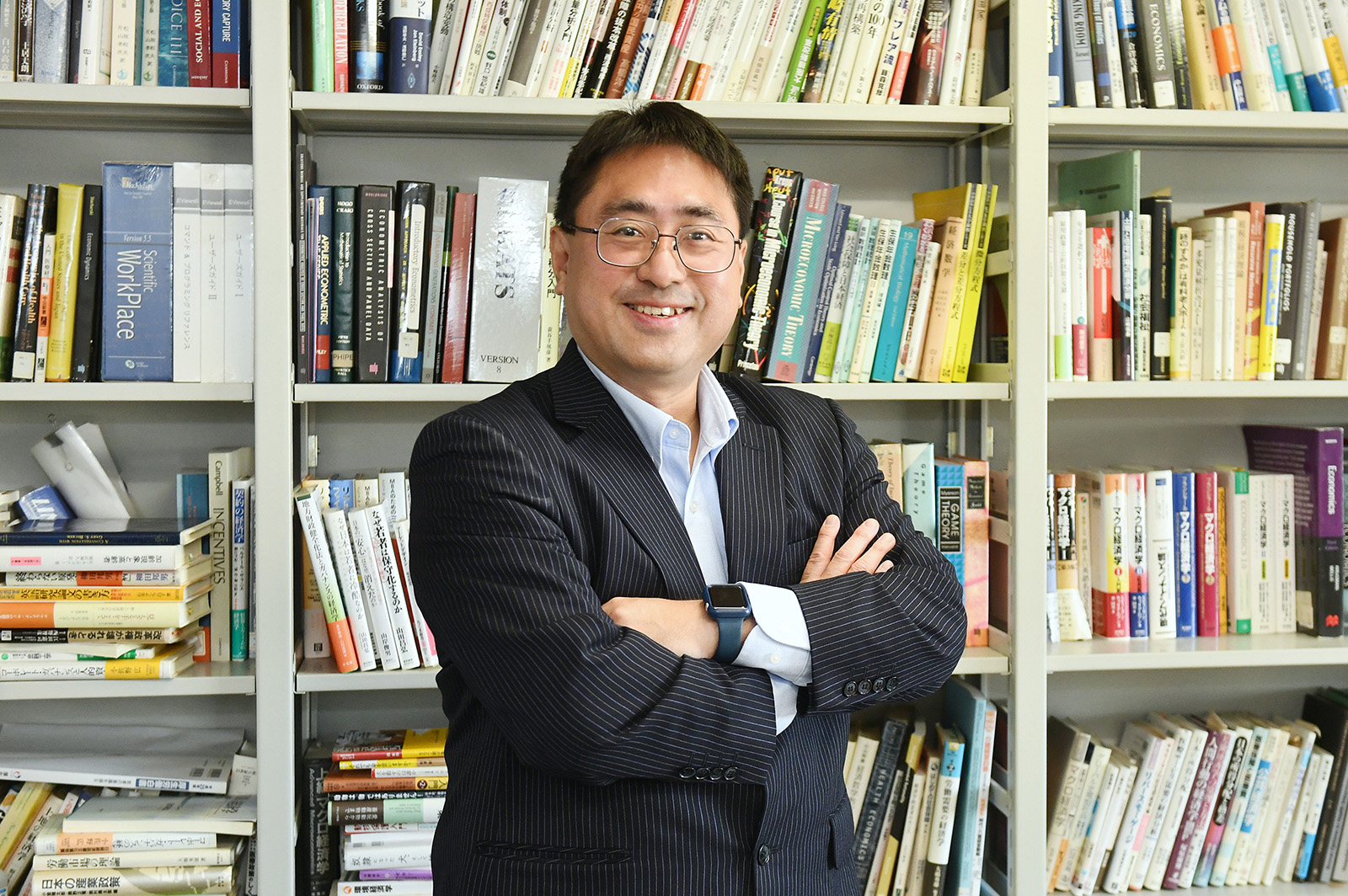
Professor Wataru Suzuki
- Research Fields
- Social Security, Health Economics, Welfare Economics
- Profile
- Graduated from the Faculty of Economics at Sophia University. Completed master’s degree at Osaka University Graduate School of Economics, then dropped out of doctoral course (PhD in Economics) before completing required credits. Worked at the Bank of Japan 1994-1998. Earned PhD in Economics at Osaka University Graduate School. Served as assistant professor at Osaka University Graduate School of International Public Policy, and as associate professor in the Department of Integrated Social Systems Studies at the Faculty of Education at Tokyo Gakugei University, before assuming current position as associate professor at Gakushuin University Faculty of Economics, a role held since 2009. Served as member of the government’s Council on Regulatory Reform, as member of the Working Group on National Strategic Special Zones, as co-secretary-general for the Tokyo Special Zone Promotion, as special advisor to the City of Osaka, and as special advisor to the Tokyo Metropolitan Government. Published works include: Healthcare Collapse: Who is the Real Culprit?; The Social Security and Fiscal Crisis; An Economist: Aims to Eliminate Waiting Lists for Childcare; and An Economist Tackles Japan’s Re-Impoverished Regions, amongst many others.
Interview: 17 January 2023
Encounters with three mentors paved the way toward labour economics and an understanding of the structure of society

Using Economics and Data Science
Developing the Ability to Confront Various Social Issues
Why Professor Suzuki’s supervision is so popular among working students
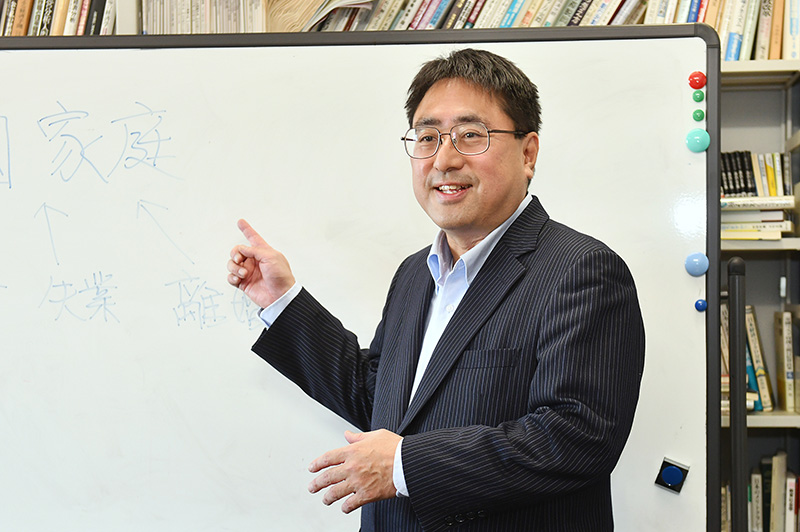
Professor Suzuki’s academic courses enjoy huge popularity among numerous working students who each have diverse goals. They are likely attracted by his research into social security, health economics and welfare economics - areas that address a wide range of social issues - and by his tailored course designs.
“Japan is experiencing an unprecedented rapid decline in its birthrate and the aging of its society. Social issues such as pensions, healthcare, nursing care, measures to combat the declining birthrate, welfare assistance and homelessness are extremely serious. My research topic is an interdisciplinary field that attempts to approach solutions to these issues through empirical analysis using econometrics and field surveys. As a result, the interests of my students are broad; in addition to those aiming to become researchers in the ‘Researcher Training Course’, some students enrol in the master’s ‘Specialised Training Course’ to put their advanced expertise to good use in their careers.”
So, what kind of research topics do Professor Suzuki’s students actually tackle? When I asked him, I found that the topic titles alone were diverse and full of interesting themes.
“Some students have used their experience working with big data at think tanks to analyse medical expense claim data, some have analysed local government welfare finances, and others have used statistical methods to analyse medical product pricing.”
Working students under Professor Suzuki’s supervision have researched topics including the following: ‘Analysis of the effects of increasing copayments using health insurance claim data’; ‘Statistical analysis of medical malpractice using court precedent data’; ‘Analysis of determinants of local government welfare finances’; ‘Conjoint analysis of pharmaceuticals’; ‘Applied general equilibrium model analysis of Japan-China trade’.
Students are encouraged to be uncompromising in their choice of research topic. One major advantage is the comprehensive guidance system that has been implemented.
There’s another reason why Professor Suzuki’s supervision is popular with working adults. His teaching philosophy is unique and he has put in place various ingenious methods to create an ideal research environment.
“Rather than suggesting a direction for research or methods to employ, I try to help each individual student find their own path. Once that path has been selected, I accompany them and offer advice whenever they come to a crossroads. However, there is one thing I always emphasise: ‘Don’t decide on a research topic lightly; rather, find something truly meaningful and that is useful to society.’ I also try to create as many opportunities as possible for students to learn from one other. Currently, students are working on diverse research topics, such as discrimination against women in the workplace, regional development and migrant labour issues. There is a forum where they can exchange ideas, which often helps them discover new perspectives and methods. In addition to this, three faculty members supervise the specialised training course, each of them bringing strengths that are utilised to deepen students’ research and reinforce their practical skills.”
What’s important is an awareness of the problem and the motivation to study what you want to study
A research field that can be applied to a wide range of real-world situations and a comprehensive support system: these have been by no means superficial developments, but are deeply connected to Professor Suzuki’s own experiences.
“I left the Bank of Japan, where I had been working since graduating from university, and went back to graduate school to earn a master’s degree and doctorate. Looking back, I feel that the strengths of students with prior work experience are that they have a strong awareness of the issues surrounding their research themes, and that they know how to use their time efficiently.”
The strengths that only someone with a professional history who goes on to graduate school can know. This is the very foundation of education.
“The field of economics is often thought of as a liberal arts field, but I have been working to solve social problems using a variety of analytical methods, including field surveys, GIS (geographic information systems) analysis, statistical analysis of big data, microsimulation models and macro econometric model analysis. Our Graduate School of Economics also offers many opportunities to learn about AI, machine learning and programming, which I believe are valuable for working professionals seeking to reskill.”
I now had a concrete idea of how cutting-edge research methods could be used to approach various social issues. However, Professor Suzuki said there was an even more important purpose to studying at graduate school. When I asked him what kind of students he aimed to attract, I was given a fundamental response:
“What’s important isn’t knowledge or experience, but the motivation to study what you want to study. I want students to have a sense of problem-solving and who want to apply economics to solving social problems.”
With the clear goal of making a contribution to society using the most appropriate methods to find solutions, the research themes that students are working on under Professor Suzuki’s tutelage are likely to continue to expand infinitely.
Positions and affiliations reflect information at the time of the interview.
Positions and affiliations reflect information at the time of the interview.