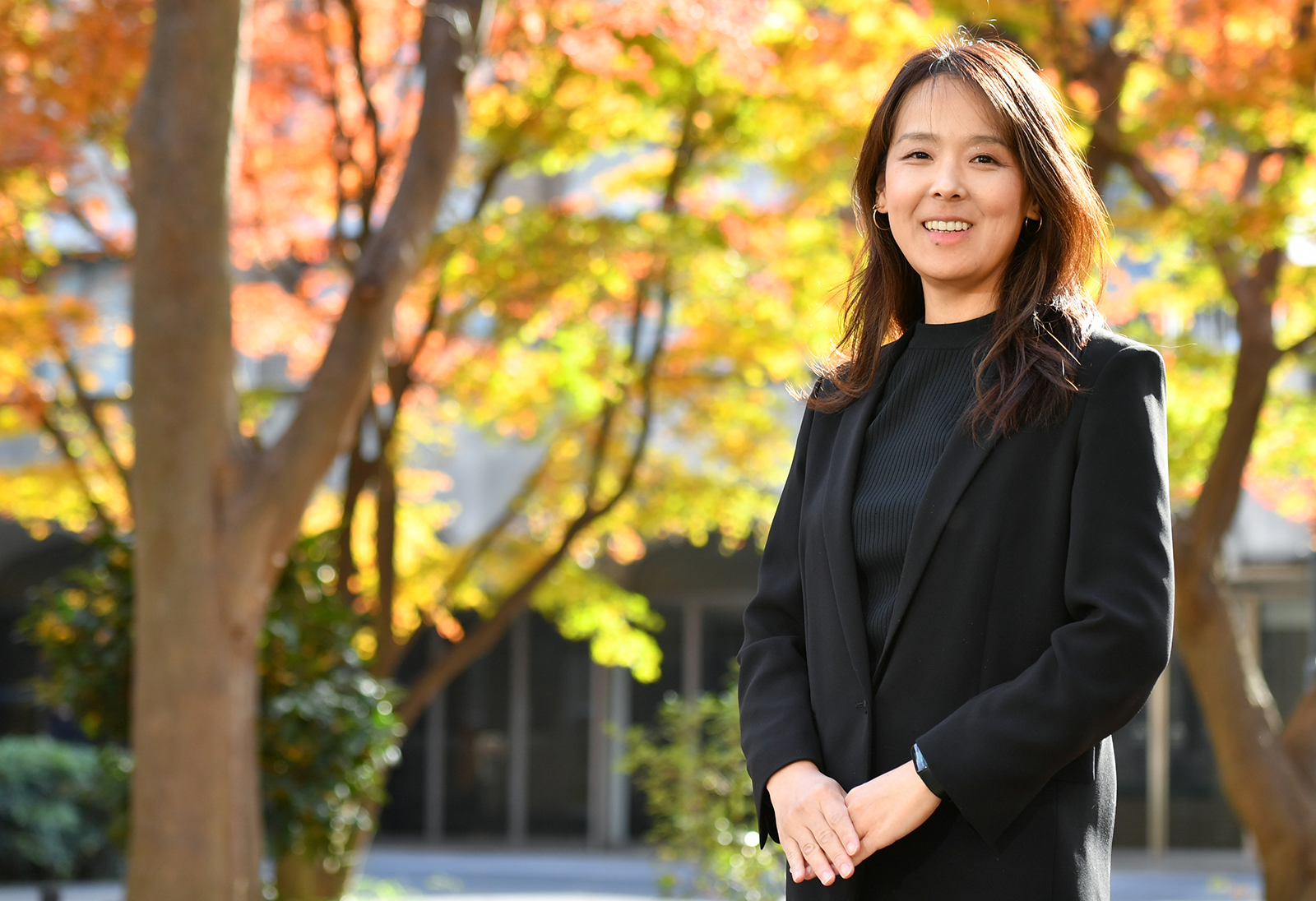
 Interview
Professor Miho Takizawa
- Research Fields
- Empirical research on macroeconomics, empirical analysis of corporate behaviour, productivity analysis
- Profile
- Graduated from Gakushuin University Faculty of Economics in 2002. Received PhD in Economics from Hitotsubashi University Graduate School of Economics in 2008. Became full-time lecturer at Toyo University Faculty of Economics in 2008. Became associate professor at Gakushuin University Faculty of Economics in 2019. Became professor in 2020. Served also as visiting scholar at Harvard University Centre for International Affairs, and as a postdoctoral fellow at the Japan Society for the Promotion of Science.

The Cutting Edge of Macroeconomics: Uncovering the Value of Productivity Through Corporate Data Analysis
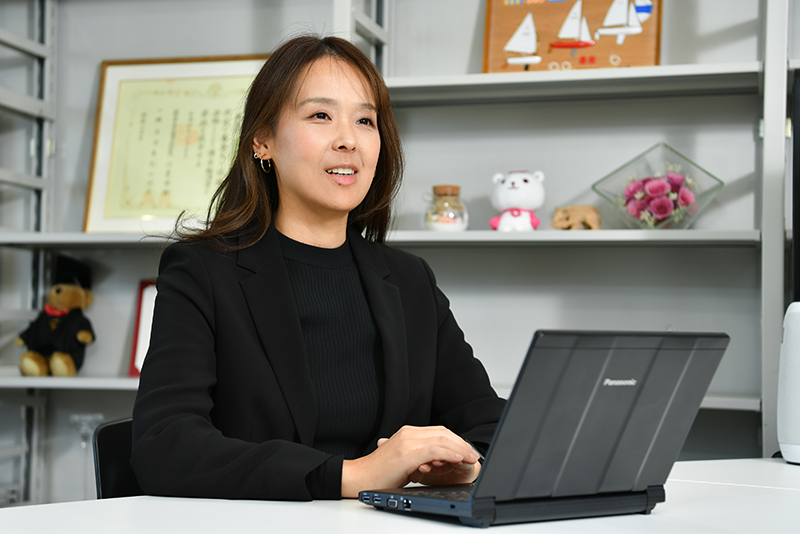
Big data offers remedies for the Japanese economy
Macroeconomics takes a bird’s-eye view of a country’s economy as a whole and reveals the mechanisms of economic fluctuations and growth that lie beneath. This academic field, which once primarily focused on the construction of theoretical models, has undergone a paradigm shift in recent years. Advances in computer processing power have made it possible to conduct sophisticated empirical analysis using massive amounts of corporate data on millions of companies, known as big data.
Professor Miho Takizawa, who has served in numerous important roles, including as a government council member and an external director for companies, remains at the forefront of macroeconomics and continues to harness the power of data to tackle the structural challenges facing the Japanese economy.
“Macroeconomics, as the name suggests, is a discipline that considers ways to improve a country’s economy from a macroscopic perspective. The Japanese economy has been stagnating for the past 30 years, and my research focuses on uncovering the causes and finding solutions to get it back on track. While theoretical research using pen and paper to solve mathematical equations was once the norm, we live in an age when even researchers like those of us in the humanities can use high-performance computers. For about 15 years, I’ve been conducting empirical research focusing on both macro and micro aspects, analysing detailed big data from millions of companies to determine how to increase the productivity of individual companies (micro), in order to improve the national economy (macro).”
After analysing massive amounts of data, the challenges facing the Japanese economy were identified: productivity, which is the source of economic growth, is sluggish, and it suffers from a lack of investment. In Japan, where the population is declining, the only way to maintain and improve the country’s current standard of living is to increase the economic contribution of each individual: in other words, increase productivity.
Professor Takizawa is particularly focused on investment in ‘human capital’. The results of her data analysis reveal the harsh reality that Japanese companies have neglected investing in employee training and skill development over the past 20 to 30 years. The price of neglecting the workforce as a resource is likely manifesting itself in the stagnation of the economy as a whole. Now that mandatory corporate disclosure has become more widespread and detailed data on human capital is available, the need to understand the mechanism by which productivity improves when companies invest in people appears pressing.
In addition to these research activities, Professor Takizawa is deeply involved in social implementation beyond the confines of academia. As well as serving on councils for the Cabinet Office and the Ministry of Finance, she often visits companies to provide consulting services. At first glance, her busy schedule may seem to eat into her research time, but there is a clear purpose behind it.
“While it’s true that I spend a significant amount of my five-day week working outside of the university, I view this as an essential part of my research. The latest international comparative data and policy issues shared by government advisory councils allow me to identify the real issues facing the Japanese economy, and companies also provide me with valuable internal data. By going out into society and striving to contribute, I gain perspectives and data that are useful for my research, and then I can give the results of my research back to society. I believe it’s a win-win situation.”
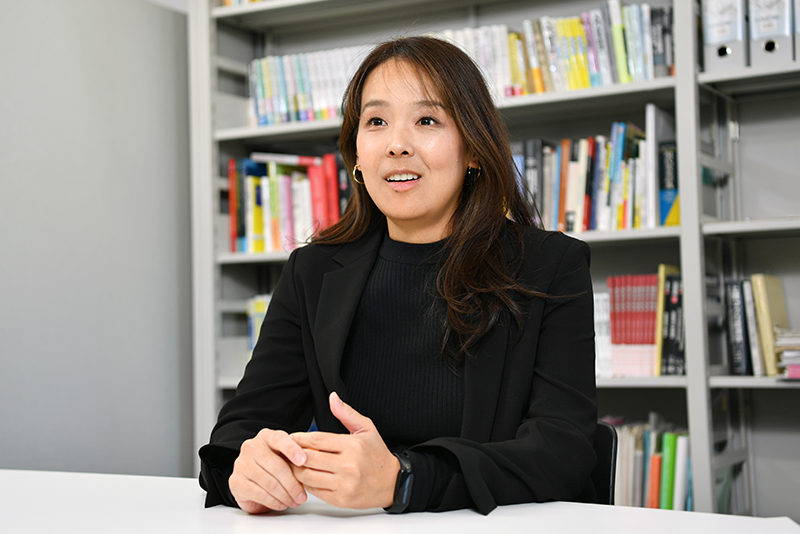
A research career moulded by the advice of three mentors
Professor Takizawa continues to work at the forefront of her field, but her roots as a researcher lie here at Gakushuin University. As an undergraduate, she enrolled in the Department of Economics with the ambition of “pursuing international studies”. However, an encounter with a certain professor would set the future course of her life.
That turning point came when she joined a seminar group led by Professor Tsutomu Miyagawa, who had just taken up his post. Professor Miyagawa, a leading expert in macroeconomics – and, in particular, productivity research - was energetic and surprisingly close to his students. After rigorous seminars, he would host dinners with his seminar students almost every week, where he passionately discussed everything from the joys of academia to his philosophy on life. Inspired by this overwhelming enthusiasm, it was only natural for Professor Takizawa to aspire herself to become a researcher.
She then went on to graduate school at Hitotsubashi University on the recommendation of Professor Miyagawa. However, what awaited her there was the brutal reality of the outside world. Leaving the warm learning environment of Gakushuin, she found herself surrounded by a large number of other talented students, which was a shock to the system. In addition to the rigours of studying for her master’s, she felt constant pressure to surpass the requirements for advancing onto the doctoral programme. Professor Takizawa says that it was Professor Kazumi Asako, one of her supervisors there, who supported her through this period.
“The truth is, I wasn’t able to prepare my master’s thesis satisfactorily, and I was worried about my future. Professor Miyagawa severely reprimanded me for not taking a serious enough approach to my research. At that time, Professor Asako gave me words of encouragement, even though I was struggling. His kind words, reminiscent of Coach Anzai from the manga ‘SLAM DUNK’, helped me believe that it was okay to continue my research.”
During her doctoral studies, Professor Takizawa also received guidance from Professor Kyoji Fukao, another leading figure in Japanese productivity research. She recalls being deeply inspired by Fukao’s acute and forthright intelligence.
Guided by these three mentors, Professor Takizawa became a full-time lecturer at Toyo University after earning her doctorate. She later studied abroad at Harvard University as a visiting researcher. Liberated from the demands of university classes, she enjoyed the luxury of being able to immerse herself in research from morning until night. Out and about in Boston, she encountered superstar economists whose names she had only seen in textbooks. The year she lived there, interacting with professionals from a variety of fields and being able to spend time deep in her own thoughts, was a valuable experience that greatly broadened her horizons as a researcher.
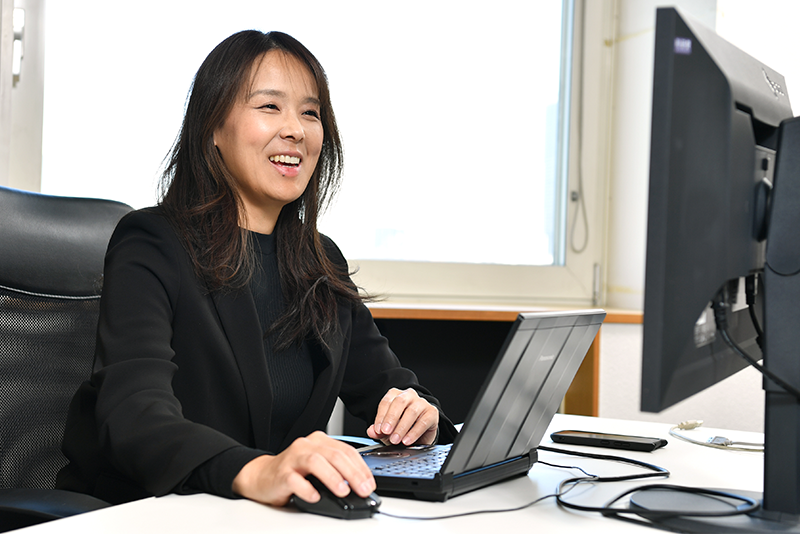
Sharing a rich academic experience with the upcoming generation
After experiencing the outside world and gaining teaching experience at other universities, Professor Takizawa returned to her alma mater, Gakushuin University, in 2019. Now that she has transitioned from student to teacher, she once again feels the overwhelming ‘closeness’ that exists at Gakushuin but is not found at larger graduate schools.
At very large graduate schools, it is common for one faculty member to have many graduate students, making it difficult to find time for in-depth discussions with supervisors. At Gakushuin, in contrast, the number of graduate students is limited, so the relationship between faculty members and students is nearer to one-to-one than one-to-many. For aspiring researchers, being able to receive exclusive supervision from researchers who are both at the forefront of their fields and have a significant social presence is an unparalleled luxury. The small class sizes also offer a significant advantage to those students who wish to study while working at the same time. Graduate school lectures, typically held during the daytime on weekdays, present a significant challenge for students who also have jobs, but small class sizes allow faculty members to be flexible with them.
“Even if it’s difficult for people to attend lectures, we can accommodate by adjusting schedules or providing one-on-one instruction. In fact, I’m seeing an increasing number of professionals being accepted as graduate students. Today’s society places a lot of emphasis on the importance of ‘recurrent education’ (relearning), and absorbing new knowledge is truly an investment in your own human capital. For working adults with professional experience, acquiring academic knowledge will be a major benefit both to their own careers and to the Japanese economy.”
Flexible and intensive: Professor Takizawa says she wants the upcoming generation to enjoy the valuable experience she herself gained at Gakushuin. As a ‘Gakushuin alumna’, Professor Takizawa considers it her responsibility to pass on the teachings of her mentors and to produce researchers and practitioners who will shape a new era.
“Under the guidance of my mentor, I learned how to handle data and kick-started my career by having my name included in a co-authored paper. Now it’s my turn to assume that role. My current goal is to share my data and analytical know-how freely, to conduct research jointly with students, and to publish the results in the form of theses and journal articles. I’m looking forward to the day when I can conduct research with similar colleagues who are motivated to sit down and focus on research in a quiet environment, and who want to solve social issues through data analysis.”
| Date of interview: | 15 November 2025 |
| Interviewer/writer: | Hiroyuki Tezuka |
Positions and affiliations reflect information at the time of the interview.
Date of interview: 15 November 2025 / Interviewer/writer: Hiroyuki Tezuka
Positions and affiliations reflect information at the time of the interview.