 Interview
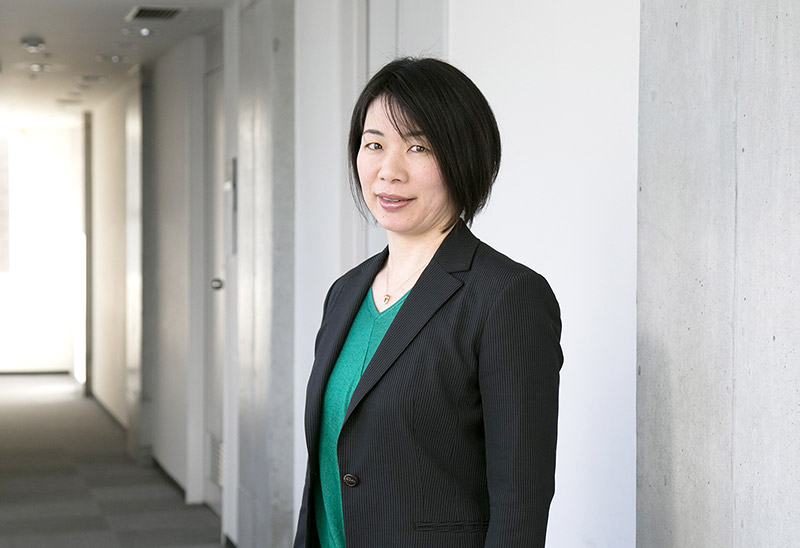
Professor Ayako Kawai
- Research Fields
- Management Information Systems, Operations Management, Supply Chain Management
- Profile
- Graduated from University of Tsukuba College of Policy and Planning Engineering (now the College of Science and Engineering) in 2000. Worked at a logistics company until 2003, when she enrolled on a master’s programme at University of Tsukuba Graduate School of Systems and Information Engineering. Completed master’s programme in 2005 and proceeded to doctoral course. Completed doctoral course in 2008 and became a researcher in the university’s Service Innovation Project. Joined Takachiho University Faculty of Business Administration in 2010. Joined Department of Managament at Gakushuin University’s Faculty of Economics in 2017.

Towards a Happy, Friendly Supply Chain for Everyone
In pursuit of the ideal method of passing the baton
Supply chain management (SCM) is a business management methodology that comprehensively reviews the flow of raw materials needed to produce products or services, from an end-to-end perspective. It examines the chain from the perspectives of both logistics and information, with the aim of making it as efficient as possible and streamlining the entire process. Professor Ayako Kawai says her interest in logistics began when she worked part-time at a Seven-Eleven convenience store during her first year at university.
“At the time, POS (point-of-sale) registers were a novelty. With a simple beep of the register when an order was placed, a forecast of product demand would appear on a handheld terminal, providing a guide for order quantity. An order placed in the morning would be correctly delivered by the afternoon. I was impressed by this cutting-edge technology and became intrigued, wondering how it was all possible.”
One of Professor Kawai’s current research interests is ‘Industrie 4.0’, also known as the ‘connected factory’ or ‘smart factory’. The use of Internet of Things (IoT) technology to collect large amounts of data in real time allows one to instantly view the status of production, logistics and inventory at any given moment. This enables dynamic capture of inventory details with a time axis, such as showing how it will modify next, a feature which can dramatically improve the quality and accuracy of information.
“Once connected factories become fully operational, ideal inventory targets can be set in advance at each point in the supply chain, automating order and shipping processes. What should the order quantity be? What is the current inventory status? The platform supporting these businesses will be able to automatically and flexibly manage the flow without human decision-making, seamlessly passing the baton to the next organisation in the chain.”
There’s a difference between working and performing a job. Professor Kawai says that, when this distinction can be identified, humans will be able to focus their resources on the types of work that AI cannot assume: on tasks that only humans can do.
“For example, what should we do to grow our business? What kind of services and products can we provide, and how can we provide them to our customers’ satisfaction? We’ll be able to focus on the things that only humans can do, such as designing and delivering services and products. I believe that, by removing tasks that can be performed by non-humans, the value that only humans can bring can be taken to the next level, so I approach my research with a sense of mission.”
Towards sustainable optimising entire processes
Another focus of Professor Kawai’s work is ‘reverse logistics’. In contrast to logistics, which refers to the distribution management of goods from producers to consumers, closed-loop logistics relates to the reverse process: goods flowing from consumers to producers.
“Traditionally, a product would reach the consumer, be used, and then eventually become obsolete and would be disposed of, ending its life cycle. However, in recent years, the public has become increasingly critical of businesses over environmental concerns. Companies that manufacture products are being asked how they will collect and recycle them when consumers no longer need them.”
As an approach towards a circular economy in which products that have outlived their usefulness can be given new life in some form, Professor Kawai says the ‘closed-loop supply chain’ has become a hot topic, since it “considers the process not just as a flow, but also includes aftercare processes, such as reuse and recycling, all the way to collection and closing of the loop”.
So, what ideal does Professor Kawai have in mind as she approaches her research?
“In Japan’s centres of manufacturing, every company is diligently working on ‘Kaizen’ (improvement) activities to increase productivity, driven by the idea that every second counts. However, compared to other developed countries, Japan currently faces productivity challenges. Productivity is not in fact that high, not only in the service industry, as is often noted, but also in manufacturing industries.
“Even if your company has reduced unnecessary inventory to the bare minimum, when you look at the entire supply chain there may actually be piles of excess stock somewhere. From an SCM perspective, it’s said that not much has changed in the last 20 years. There are cases where subcontractors are holding unnecessary stock to support the contracting company’s zero inventory, and I don’t think this is making people happy overall. It creates waste and means that many people are doing unnecessary work.
“If each company can share the inventory risks that needs to be held as a buffer and creates a mutually beneficial supply chain, everyone should be able to run a more efficient, productive business with more flexibility. I would like to study SCM in depth so that everyone can be happy.”
What can be gained from research and what is expected of graduate students
“In my graduate seminar this year, we read specialised books on operations and supply chain management, with each of us presenting on the section we had worked on, followed by a discussion based on that. When I asked the graduate students for feedback on how it went, the response was encouraging: ‘Studying broadly and superficially is enjoyable, but I’d like to gain a broad understanding and then delve deeper into areas that interest me.’ I’m inspired by students’ enthusiasm for their studies. So next year we plan to study different specialised books at a faster pace, then choose one or two topics that interest us, dig deeper into them, create case studies, and conduct analysis and research.
“We also have exercises aimed at writing papers. One student is using data collected from a business game on SCM named “elephant game” to analyse trends in how supply chain performance changes depending on strategic patterns. I hope to see that student go on to present at academic conferences.”
The ‘elephant game’ is a simulation exercise devised by Professor Kawai and Associate Professor Oe Akitsu of Nihon University to give students hands-on experience of key SCM principles. It is based on the ‘Beer Game’ invented at the Massachusetts Institute of Technology, but it can be played in a surprisingly short time, making it a popular training tool for consulting firms, major manufacturers and public interest corporations in the logistics field in Japan. Having been able to connect with companies through this game, Professor Kawai is enthusiastic about having students conduct collaborative research with organisations at the forefront of logistics.
So, what are the advantages of studying this field? And what kind of students would Professor Kawai like to attract?
“My research is essentially about creating a platform for supporting marketing and strategic development, so it may not sound flashy. But because I work behind the scenes, I can put that knowledge to good use in a wide range of areas. As the topic is specific and practical, it will be a very powerful tool for those who become users of it, and once they have mastered it, I believe those people will immediately become effective.
“In fact, I spent two years studying for my master’s degree, acquiring specialised knowledge, and had planned to return after completing it to a consulting firm or similar. However, I found research so fascinating. There are many aspects of SCM that are yet to be explored, and new technologies are constantly being developed. Also, the flow of goods will never disappear unless we invent a teleportation device. In that sense, I think this is a very interesting field for anyone aspiring to become a researcher.
“Of course, undergraduate students from our faculty are welcome to move up to the graduate level, but I’m also happy to see people who have entered the workforce and developed their own sense of awareness of issues before wanting to learn and delve deeper into this subject. That’s what I did. Whether they’re from undergraduate school or are working professionals, those who come to study having already formed an awareness of issues in their own minds will each have entirely different sets of open circuits. Even if you read the same content, listen to the same talk or visit the same workplace, your perspective will be different, and your speed of understanding will be on a whole different level. I’m looking forward to meeting people who have a clear sense of awareness of problems in the real world around them.”
| Date of interview: | 25 January 2018 |
| Interviewer/writer: | Kazuya Endo Office |
| Photography: | Kento Matsumura |
Positions and affiliations reflect information at the time of the interview.
Date of interview: 25 January 2018 / Interviewer/writer: Kazuya Endo Office / Photography: Kento Matsumura
Positions and affiliations reflect information at the time of the interview.