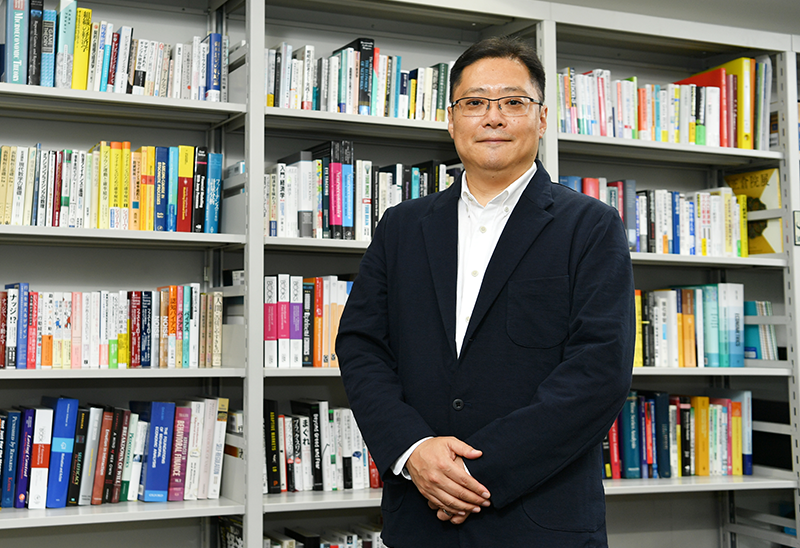
 Interview
Professor Yutaka Kayaba
- Research Fields
- Behavioural Economics, Experimental Economics, Applied Econometrics
- Profile
- Graduated from the Department of Economics at the University of Tokyo Faculty of Economics in 2002. Worked at the Financial Bureau of the Ministry of Finance and the Sapporo Regional Taxation Bureau of the National Tax Agency from 2002-2005. Completed master’s degree at University of Tokyo Graduate School of Economics in 2007. Completed PhD in Social Sciences at the California Institute of Technology's Graduate School of Humanities and Social Sciences in 2012. Became Assistant Professor at University of Tokyo Graduate School of Economics in 2013. Became Specially Appointed Lecturer at Hitotsubashi University Institute for Advanced Study in 2015. Became Specially Appointed Lecturer at University of Tokyo Graduate School of Economics in 2017 and, later, became Lecturer. Has held current position since 2025.

Behavioural Economics Explores Human Irrationality. At Gakushuin, We Can Explore Unanswerable Questions Together.
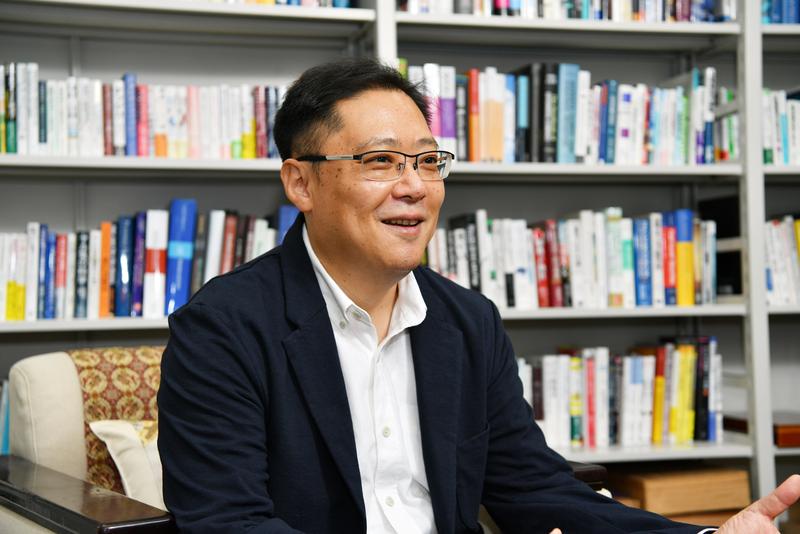
Why do people make irrational decisions? Behavioural economics uncovers the truth behind society’s choices
We are surrounded by mysterious decision-making processes. “Even though I know I should be saving up or studying for my future, I keep putting it off.” Or, “I know I’m on a diet, but I still grab that sweet treat in front of me.” Professor Yutaka Kayaba’s speciality, behavioural economics, seeks to explain human behaviour such as this from an economic perspective.
“Traditional economics has constructed theories on the assumption that humans are highly rational beings who act to maximise their own interests. Of course, when considering a company’s competitive strategy, for example, analyses based on rationality are extremely important. However, when we look at the behaviour of individuals from the perspective of what they choose to consume, or of the health-related decisions they make, we see that there are aspects that cannot necessarily be described as rational. Behavioural economics builds its theories that incorporate this more realistic view of humans.”
Behavioural economics, a field with a long history, has only begun to gain attention in the last 20 years or so. Its recognition spread after Professor Daniel Kahneman was awarded the Nobel Prize in Economics in 2002, and the frequent occurrence of financial crises such as the Lehman Shock led to a surge of interest in economic phenomena that cannot be explained by rationality alone. In recent years, this knowledge has begun to be applied to society in more practical ways. A prime example is ‘nudge theory’, proposed by Professor Richard Thaler, who was awarded the Nobel Prize in Economics in 2017.
“Nudge mechanisms are those that gently prod people into taking desirable actions when it is difficult for them to make rational decisions. For example, simply adding a sentence like ‘Many people have already made appointments’ to an invitation for a health checkup could increase appointment attendance rates. Research groups at Osaka University and other institutions have studied effective nudges as infection control measures for rubella and COVID-19, and have contributed to their implementation in society, making nudges commonly known among the general public. Today, many government officials use the idea of nudges in public policy to solve various social issues, including environmental problems.”
At the same time, Professor Kayaba warns of more complex problems lurking in modern society, particularly in the digital space where social media has become widespread. Recently, the Kayaba Laboratory has been focusing on a research topic known as ‘narrative economics’.
“Narratives are stories that influence how people understand things and make decisions. Professor Robert Shiller (2013 Nobel Prize in Economics), a proponent of applying narratives to economics, pointed out that economic fluctuations are heavily influenced by specific stories that spread among people. For example, when a country’s leaders tell a story with a clear structure of good and evil, such as, ‘We are imposing high tariffs to punish unjust entities that threaten our way of life’, people tend to accept it emotionally. Our brains have a cognitive tendency to prefer simple stories over complex data.”
When these narratives are combined with social media algorithms, they can sometimes fuel divisions among people and hinder rational decision-making. Professor Kayaba highlights that there is a danger that this phenomenon could have the opposite effect to a ‘nudge’.
“Mechanisms that steer people’s decision-making in the wrong direction are known as ‘sludge’, or, especially online, as ‘dark patterns’. When watching short videos on social media, for example, they are full of devices that incite anger and anxiety in viewers, leading them toward certain ideologies, or reinforcing ‘confirmation bias’, where viewers are bombarded with only the information they want to see and are shielded from opposing views. Whether or not this is the intention of the operators of social media platforms, these videos can be said to function in practice as a mass of sludge that cleverly exploits narratives. I’m currently asking my seminar students to act as investigators, telling me if they find any sludge lurking in society. There’s an endless supply of research topics floating around in our daily lives.”
Behavioural economics begins with the microscopic perspective of individual decision-making, but connects to all sorts of fields, from marketing and organisational theory to financial and social issues. It is this dynamism that is so appealing and captivating to many people.
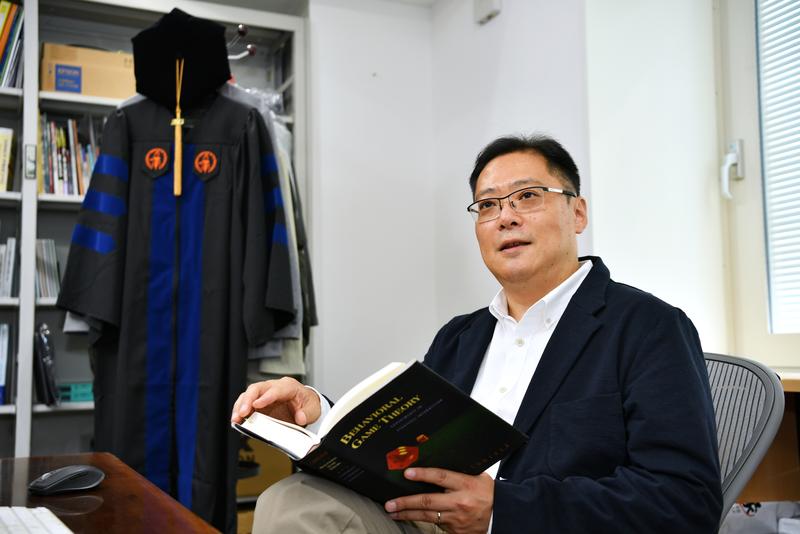
Driven by intellectual curiosity: From the Ministry of Finance to world-class research
Professor Kayaba has a unique career background. When he first entered the University of Tokyo, he enrolled in a science course. However, a television programme he saw during his first year at university changed his life dramatically.
“In 1997, the Nobel Prize in Economics was awarded in the field of financial engineering, and a special TV programme was broadcast explaining just how impressive that theory was. However, midway through the transmission, Long-Term Capital Management (LTCM), a company founded by the very Nobel laureates who had been putting that theory into practice, went bankrupt. The programme started by focusing on the theory’s brilliance, but halfway through it shifted to explaining why it had failed. I was shocked to see how what was thought to be a complete theory could so easily fall apart in the real world. I thought, ‘There’s still so much that is unknown in this field, and it’s full of new discoveries. How fascinating!’ and decided to switch to the Faculty of Economics.”
Professor Kayaba’s pure intellectual curiosity was further honed during his third year of undergraduate studies when he joined a seminar taught by the then Professor Motoshige Ito. At the time, the dot-com bubble was at its peak in the United States, and the market was dominated by a frenzy of rising stock prices for internet-related companies. The seminar group, meanwhile, was reading a book called The Irresistible Exuberance by Professor Robert Shiller, who would go on to win the Nobel Prize in Economics.
“In this book, Professor Shiller calmly argues, based on data, that ‘This is a bubble’, without being swayed by public opinion. Professor Ito said, ‘An important job of economists is to examine what is wrong in the world and make recommendations to correct it,’ and I was deeply impressed by these words. Professor Ito also always told us that, ‘If you want to become a researcher, you should study abroad.’ Influenced by the fact that many of my fellow seminar students were also eager to study overseas, I began making preparations to study abroad with an eye on my future career, whether that meant finding a job or becoming a researcher.”
In fact, Professor Kayaba did not immediately go on to graduate school, instead choosing to join the Ministry of Finance.
“I had originally decided to work for three years and then consider a career in research if I still had a passion for it. I was assigned to the Financial Bureau, which is responsible for issuing government bonds, where my job was to monitor financial market movements on a daily basis. Watching the market’s fluctuations, I saw the same irrational human behaviour that behavioural economics deals with. Ironically, it was witnessing the reality of this that strengthened my desire to study it more deeply. While a friend working in the same economic department and I were discussing, ‘What on earth was going on in today’s stock prices?’, I realised that I preferred researching and thinking about things rather than working as a bureaucrat. Convinced of this, I decided to return to graduate school.”
Professor Kayaba returned to academia with a strong sense of awareness of all that he had that he learnt during his time in the workforce and from his encounters with real-world problems. He explains how his experience as a doctoral student at California Institute of Technology became the backbone of his career as a researcher.
“At Caltech, the number of faculty staff is extremely high compared to the number of graduate students, allowing for incredibly attentive, personalised instruction. For example, the professor in charge of my English composition class was kind enough to give me thorough feedback on how to write an English paper, which can be quite a challenge for international students. I was incredibly happy when he told me at the end of the course, ‘Your English isn’t at a satisfactory level yet, but if you keep at it, I’m sure you’ll be fine by the time you graduate’. His comment was harsh, but I could sense a definite improvement. This formative experience was the foundation of my teaching style today.”
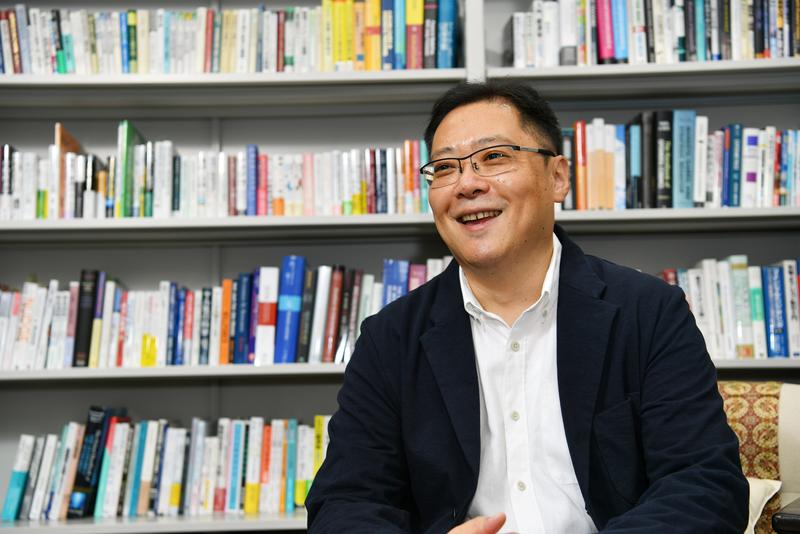
Exploring what’s ‘interesting’ together: intensive research awaits at Gakushuin
The formative experience he gained thanks to attentive teaching methods at a world-class research institution goes hand in hand with what Professor Kayaba finds attractive about Gakushuin University’s graduate school. The small number of undergraduate and graduate students creates the opportunity for more intensive instruction.
“Gakushuin is a university with a relatively small student population compared to the number of faculty members. This means professors are less likely to feel overwhelmed with students and ensures they have the time and space to properly engage with each individual. This is very similar to what I experienced at the California Institute of Technology. The perfect educational environment I benefitted from at a world-class research institution mirrors what is offered by Gakushuin. Just as my own supervisor and other faculty members treated me with sincerity, I would like to treat my students in the same way.”
Another of Gakushuin’s assets highlighted by Professor Kayaba is the character of its students. The serious attitude they show to their research is a trait found not only among young researchers in their teens and twenties, but also among the working adults who choose to study at Gakushuin.
“I feel that many Gakushuin students are serious-minded. Social psychology has shown that when people belong to a community, they tend to conform to its norms and behaviours. The culture of serious academic pursuit that is deeply rooted in Gakushuin creates an atmosphere in which students have a positive influence on each other. And when students are serious about their studies, we faculty members are eager to lend a helping hand. It’s precisely because they readily accept and take on board our advice that it’s rewarding for us as faculty to teach them. This virtuous cycle is perhaps Gakushuin’s greatest strength.
“What I sense from graduate students who have professional experience is a higher level of problem awareness. The questions and inquisitiveness they develop due to their knowledge of the real world are a huge advantage when it comes to advancing their research. And just as my own experience of witnessing the irrational nature of financial markets motivated me to pursue my research, I have no doubt that, for anyone already familiar with how society works, having the passion to delve deeply into the problems it faces is a powerful force for mastering academia.”
A dedicated approach and an awareness of issues that is developed through real-life experience. For those with a thirst for academia, says Professor Kayaba, Gakushuin is the perfect place to study.
“Research is born out of the accumulation of painstaking work, such as taking note of daily observations and writing down your thoughts. In a way, this approach is similar to that of an artist. The determination of Gakushuin’s graduate and undergraduate students is undoubtedly a great source of strength in persevering with this painstaking work. We, the faculty, want to share the experience of collaborating to create something great with people who work hard in this way.
“First of all, I want you to understand that graduate research is completely different from your previous studies. You will devise new approaches to problems for which no one has the answers, discover unknown facts from data, and write papers that communicate the excitement of your discoveries to others. This process can be difficult at times, but it is filled with unparalleled creative exhilaration and joy. If you are interested in this kind of activity, I’m sure you will have a fulfilling time at graduate school.”
Driven by intellectual curiosity, students tackle questions that have no definitive answers. They embark on a thrilling and creative journey of inquiry, closely accompanied by faculty members and fellow students. This is the kind of intense learning experience that flows through Gakushuin University Graduate School.
| Date of interview: | 10 October 2025 |
| Interviewer/writer: | Hiroyuki Tezuka |
Positions and affiliations reflect information at the time of the interview.
Date of interview: 10 October 2025 / Interviewer/writer: Hiroyuki Tezuka
Positions and affiliations reflect information at the time of the interview.