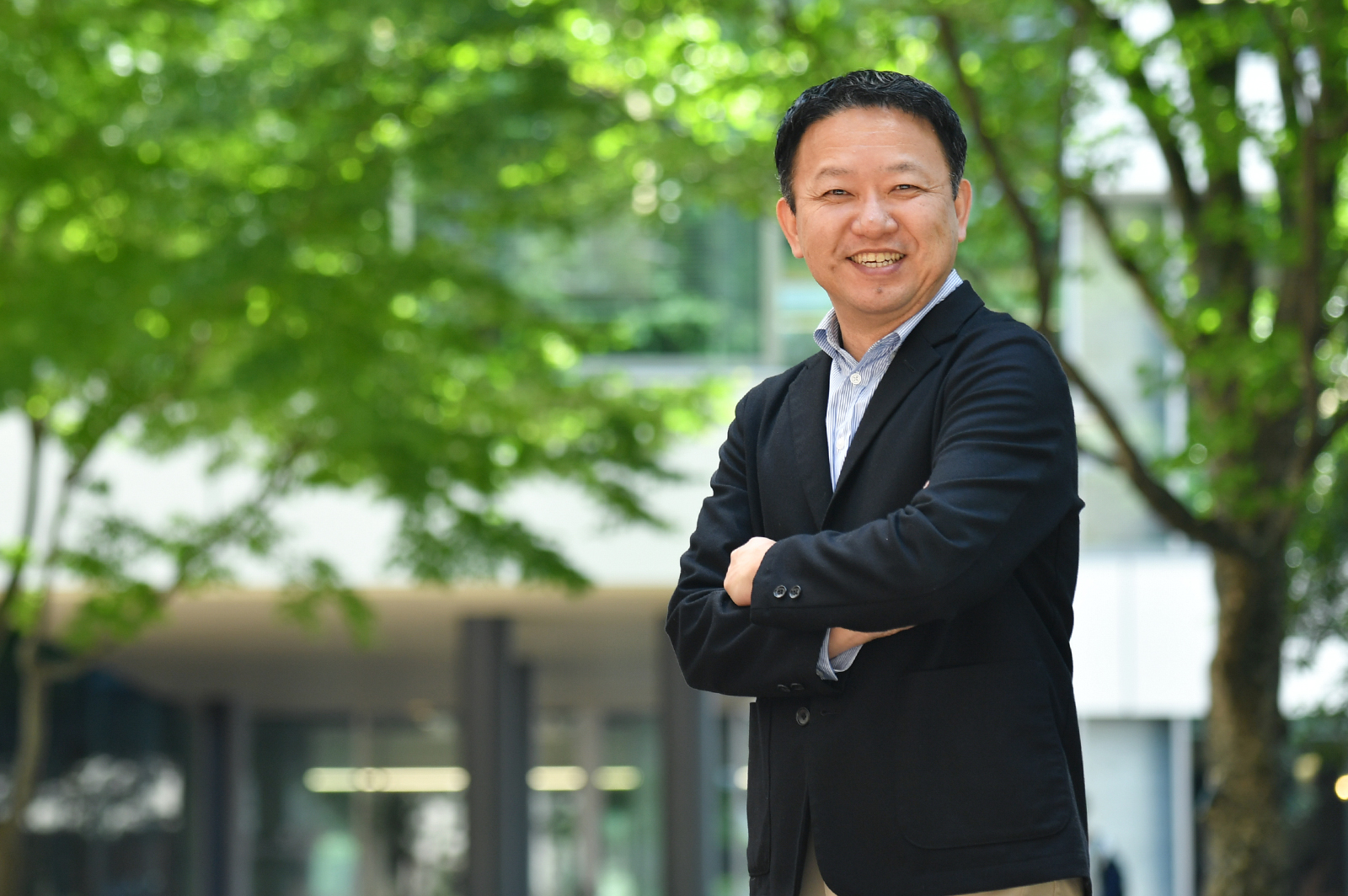
 Interview
- Profile
- Graduated from Meiji University School of Business Administration in 1995. Completed Graduate School of Business Administration at Yokohama National University in 1997. Became full-time lecturer at Rissho University School of Business Administration in 2000. Completed Graduate School of Business Administration at Keio University in 2003, earning a PhD in Business Administration. Became associate professor at Nanzan University Graduate School of Business in 2006. Became professor at Chuo University Graduate School of Strategic Management in 2012. Served as visiting scholar at Carey Business School, Johns Hopkins University from 2013-2014 and from 2017-2018. Assumed his current position in 2024.

Focusing on the Intersection of Consumer Psychology and Marketing
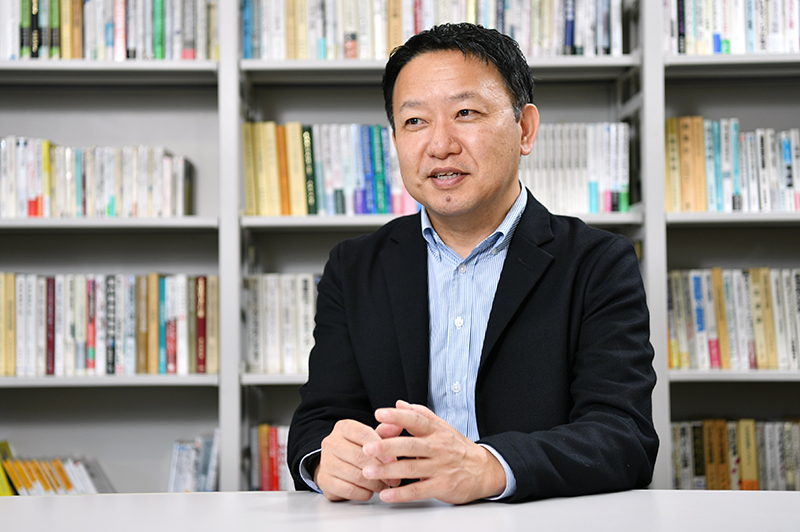
Uncovering consumer psychology from a marketing perspective
Professor Koji Matsushita of Gakushuin University’s Graduate School of Management is a marketing researcher specialising in consumer behaviour, a field that examines how consumers purchase, consume, and dispose of products and services, and the decision-making processes that accompany these behaviours. The field is approached from a variety of academic disciplines, including sociology, psychology and economics. Professor Matsushita explains: “I conduct research from a marketing perspective, while adopting a psychological approach.”
According to Professor Matsushita, marketing can be summarised by the simple phrase, “creating a system that sells.” There is a wide range of marketing activities that companies undertake when creating systems to sell their products and services, but Professor Matsushita uses brand development as an example to illustrate his research style.
“For example, let’s imagine a certain brand of toothpaste. This brand has green packaging and positions itself as preventing periodontal disease. If consumers aren’t aware of the toothpaste’s features, such as its name, the colour of its packaging and its selling points, then the product cannot be said to have been established as a brand. In other words, it cannot be said to have been ‘branded’. For brand value to emerge, the brand needs to be ‘identified’ as having some kind of distinctive characteristic.”
“As a brand marketer, you want consumers to buy your particular brand of toothpaste if they want to prevent periodontal disease. And you want to reach the point where the brand becomes indispensable to them. The brand’s name and colour may be the first thing that comes to mind when consumers are choosing toothpaste. When this happens, we might say that the brand is a ‘strong brand’.
“For marketers, building a powerful brand is one of their goals. But how can companies effectively influence consumer psychology in order to create such a strong brand? And why? These questions are an example of a style of research that sheds light on consumer psychology from a marketing perspective. I’m interested in the intersection between consumer psychology and marketing.”
Professor Matsushita has also expanded his research interests beyond marketing. He points out that one factor that influences consumer behaviour is the presence of other people. How consumer behaviour changes in response to social factors is one of Professor Matsushita’s research themes.
“Our purchases and consumption are not something we undertake in isolation. Take, for example, dining at a restaurant. The purpose of a meal is not just to obtain nutrition. There are also times when we eat to build better relationships with others, such as fostering friendships while sharing a meal. When we look at consumers as social beings, many interesting themes emerge, even just in relation to mealtimes. Of course, some of the results we obtain will also provide useful insights for the marketing of restaurants and other service companies.”
A research style informed by two turning points
In recent years, there has been an increase in the number of companies focusing on consumer behaviour analysis, with some even establishing specialised departments. However, research into consumer behaviour in Japan does not have a long history. It was in 1992, when Professor Matsushita was an undergraduate student, that the Japan Association for Consumer Behaviour Research was founded, marking the full-scale start of consumer behaviour research in the country.
Professor Matsushita reflects on the time he decided to go to graduate school:
“I was interested in consumer behaviour research and was thinking of going to graduate school, but there were very few professors specialising in the field. So, I had no hesitation in knocking on the door of the laboratory of Professor Shuzo Abe, who specialises in consumer behaviour research.”
After initiating his research into consumer behaviour under Professor Abe, Professor Matsushita then went on to pursue a doctoral course at Keio University’s Graduate School of Business Administration. As the master’s course at the Graduate School is a so-called ‘business school’, he had the opportunity to interact with many people from the corporate world. There was one viewpoint in particular that caught Professor Matsushita’s attention while studying under Professor Kyoichi Ikeo at Keio University – an experience he describes as a “turning point”:
“I studied consumer behaviour both at the Yokohama National University and at Keio University, but my viewpoint gradually shifted. Before entering Keio, I was intently focused on understanding the psychological processes of consumers. But, through my research at Keio, I came to appreciate the importance of clarifying how these processes change under the influence of marketing. It was during my time at graduate school that the foundations of my current research style were developed.”
With the examination of consumer psychology from a marketing perspective now established as his research focus, Professor Matsushita continued this work whilst teaching at universities. In the 2010s, he had two opportunities to conduct research abroad at Johns Hopkins University in the United States, where he says he was deeply inspired by the talented researchers he encountered from around the world. These overseas research opportunities marked Professor Matsushita’s second turning point.
“Through interacting with cutting-edge researchers, I came to reconsider what I could and should communicate from Japan. I realised I needed to give things a second look, including reassessing my research methods and environment.”
Against this backdrop, Professor Matsushita began tackling research that he had never previously undertaken himself. He started to focus on producing research results by collaborating with people from diverse backgrounds and, specifically, with researchers and companies from other fields.
“I conducted research in collaboration with Professor Atsunori Ariga of the Faculty of Letters at Chuo University, who specialises in cognitive psychology, and with support from the Hasegawa Fragrance Co., Ltd. (see footnote). This project revealed that the thickness of a drinking glass affects taste evaluation. I would like to continue conducting similar projects in the future.”
(Footnote) Ichimura, F., Motoki, K., Matsushita, K., & Ariga, A. (2023). ‘The tactile thickness of the lip and weight of a glass can modulate sensory perception of tea beverage’. Food and Humanity, 1, 180–187.
What graduate students need is an ‘attitude of continuous thinking’ and ‘communication skills’
Professor Matsushita joined the Faculty of Economics at Gakushuin University in April 2024. Although he has only been in his position for a few months, he has been able to sense the attitude and enthusiasm of the students there.
“When recruiting undergraduates for seminars, I met many students who showed interest in carrying out academic projects, and I'm hopeful that we can carry out some interesting projects in the undergraduate seminar as well. Similarly, if we can gather people in graduate school who are interested in the relationship between marketing and consumer behaviour, I think we will be able to work on some fascinating research.”
Professor Matsushita will also be focusing his efforts on teaching at Gakushuin University’s graduate school. He spoke about the attitudes needed to enable even more fruitful research:
“Research cannot be achieved through passive, one-way instruction alone. It’s vitally important for students to adopt an active approach and to never stop thinking for themselves. Our role as faculty is to support students in their thinking.
“Thinking things through carefully on your own is necessary, but I believe it’s also important to bring the results of your thinking to the table for wider discussion. The ability to communicate effectively is essential for conducting good research. Even if you maintain that your research is good, or if I evaluate it as such, it cannot simply be published as it stands. A paper can only be published in an academic journal after it has been read by someone other than your supervisor, and after their comments have been absorbed and suitable revisions made. For this reason, you should develop the ability to communicate your results to those around you, to be open to their feedback, and to make revisions. I believe the ideal situation would be to create a community at Gakushuin University where constructive discussions can take place.”
While Professor Matsushita is fully engaged in research in his new environment, he offered some thoughts on goals for his future research career:
“Among the projects I am currently working on are collaborative efforts with overseas researchers. I would love to publish the results of this research in an academic journal. Sharing with my graduate students the knowledge I gain from such collaborations will surely be beneficial to them as well. I am personally very much looking forward to experiences like this with them.”
| Date of interview: | 31 May 2024 |
| Interviewer/writer: | Hiroyuki Tezuka |
Positions and affiliations reflect information at the time of the interview.
Date of interview: 31 May 2024 / Interviewer/writer: Hiroyuki Tezuka
Positions and affiliations reflect information at the time of the interview.