 Contact
 Access
 Japanese
 Search





Message from the PresidentAbout Us

Gakushuin University's Upcoming Sesquicentennial
A Long History and Progressive Ethos
Gakushuin began its journey in 1877 as a school for children of the Japanese nobility. In 1884, the school was nationalized and placed under the jurisdiction of the Ministry of the Imperial Household. After the Second World War, universities were reorganized under new guidelines, and Gakushuin opened its doors as Gakushuin University, a private university, in 1949. Fast-forward to next year, 2027, and Gakushuin will celebrate its "sesquicentennial" or 150th anniversary. To this day, Gakushuin stands as an educational institution with the rare distinction of having converted from a national institution to a private one.
The roots of Gakushuin stretch back to 1847, when it was instituted in the Kyoto Imperial Palace as a place of learning for the Court nobility. Today an information board in Kyoto Gyoen National Garden commemorates this origin with the simple legend, "Original site of Gakushuin." The Kyoto incarnation of Gakushuin was scrapped, however, amid the reforms of the Meiji Restoration; 1884, the year when Gakushuin became a national school, is today taken as Gakushuin's founding year.
Gakushuin University is thus a school with a century and a half of tradition. In honor of the University's opening as a private university in 1949, Gakushuin University held 75th-anniversary celebrations in 2024. Although it struggled to attract students during the transition to postwar guidelines, Gakushuin University strove to meet the needs of each era, adding the Faculty of Intercultural Studies and two graduate schools, the Graduate School of International Social Sciences and Graduate School of International Cultural Relations, in 2026. From two original faculties, Gakushuin University has thus grown into a comprehensive university encompassing six faculties, 20 departments, eight graduate schools, and one professional graduate school, the Law School.

In this way, Gakushuin University boasts both a long history and a progressive ethos. Through small-class instruction led by faculty who are active on the front lines of education and research, Gakushuin University has sent many talented individuals into various sectors of society.
A Research-oriented Ethos
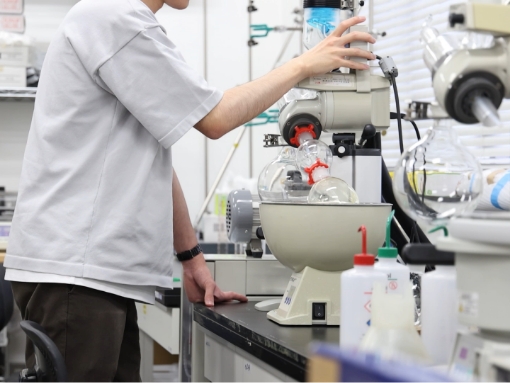
The University's Educational Objective is "to engage in deep academic research and instruction in theory and application, cultivating people of virtuous character, resolute discernment and richness of thought and feeling, who and can contribute to the creation and development of culture and to the wellbeing of humanity." As this mission statement implies, Gakushuin University is firmly rooted in an ethos strongly oriented toward research.
Objective numerical indicators testify to the fruitfulness of those labors. Gakushuin University was ranked No. 1 from the 2021 to 2023 academic years, No. 2 in the 2024 academic year, and No.3 in the 2025 academic year in new selections for approval rate for Scientific Research from the Ministry of Education, Culture, Sports, Science and Technology (MEXT), maintaining exceptional levels of academic achievement. In 2025, a Gakushuin University faculty member received the Nishina Memorial Prize, one of the most prestigious awards in Japanese physics. This brings the number of Nishina Memorial Prize recipients from Gakushuin University to four. Moreover, according to Nature Index 2018 Japan, from 2012 to 2017, Gakushuin University secured No. 1 ranking among all academic institutions nationwide in terms of an indicator of an institution's high-quality research output as a proportion of total output in the natural sciences.
This research excellence is also reflected in the education of the students who will lead the next generation. In FY2024 and FY2025, Gakushuin University graduate students received the JSPS Ikushi Prize, bringing the total number of recipients from Gakushuin University to three. Awarded to only about one in ten candidates nominated from among outstanding doctoral students across Japan, this prize demonstrates that the University's research excellence is shared not only by its faculty but also by students committed to academic inquiry.
Education That Broadens Perspectives
As these results demonstrate, Gakushuin University is a specialized educational institution of exceptional quality underpinned by research excellence. The future is by nature uncertain, however, and today's students require not only specialization but also breadth of perspective. To impart that expansiveness of vision, Gakushuin University emphasizes interdisciplinary study, transcending the confines of individual faculties. The "sub-major program," open to nearly all students at the University, enables systematic study of subjects outside the student's major. Currently three sub-majors are available under this program: Data Science, the Japanese Language Instructors Program, and Gender Studies. Moreover, the University also offers "fusion programs," multifaceted inquiries led by instructors in both the sciences and humanities. Through stimulating courses such as Sociobiology, Theory of Space Use, and Cultural Properties and Science, fusion programs foster an environment that cultivates broad-ranging perspectives. With the exception of some faculties, these courses study that transcends students' chosen fields.
People who possess both deep specialization and broad-based perspective and knowledge are known as "type-T" people. These are the people Gakushuin University hopes to cultivate.
A Peaceful Study Environment
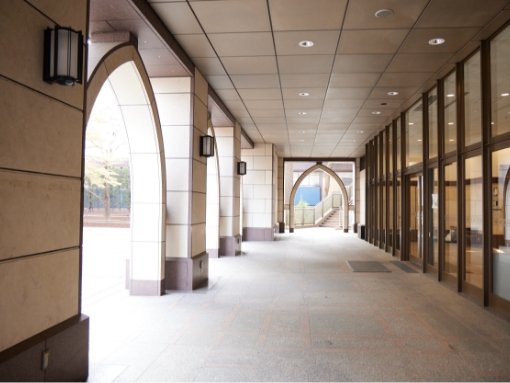
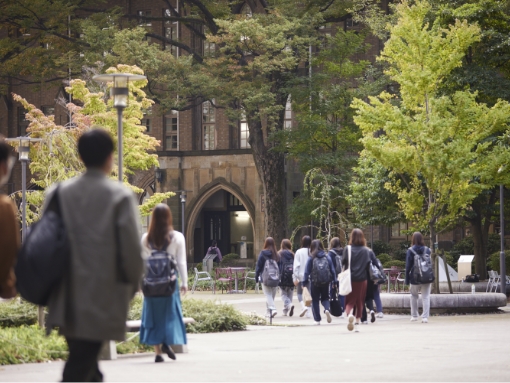
This introduction to Gakushuin University would not be complete without an introduction to the study environment itself. Mejiro Campus, the heart of Gakushuin University, is unbeatably convenient, located just a 30-second walk from Mejiro Station on the JR Yamanote Line, yet it boasts a spacious 180,000-square-meter campus. Its lush greenery has earned it the affectionate nickname "Mejiro no Mori."
Mejiro Campus also takes pride in its harmonious blend of historic buildings and leading-edge facilities. Seven buildings currently used for lectures and other purposes are nationally listed as Tangible Cultural Properties. East Building No. 1, completed in 2023 and housing the University Library among other facilities, is praised for its functionality, even earning the Japan Library Association Architecture Award for 2025. The Old Library Building, designed by Kunio Maekawa, a giant of modernist architecture, was reborn in 2025 as Kasumi Kaikan Memorial Gakushuin Museum, with assistance from the Kasumi Club (former Peers' Club), and now serves as a new beacon of culture.
Unusually for a university in the heart of a major city, Mejiro Campus is also home to stables housing a dozen or so horses and a pond inhabited by ducks and carp. Reverberating with abundant natural beauty, tradition, and modernity, Mejiro Campus is an oasis of calm where students can forget the tumult of the city and immerse themselves in scholarly pursuits.
Striving for Further Innovation
Today Gakushuin University is in the midst of a major transformation. In 2026, through a merger with Gakushuin Women's College, Gakushuin University opened its sixth faculty, the Faculty of Intercultural Studies. In tandem, the University established two new graduate schools, the Graduate School of International Social Sciences and Graduate School of International Cultural Relations.
While our domains of academic inquiry have broadened, our advance never falters. Gakushuin University continues to implement decisive reforms to move with the changing times, as exemplified by the current deepening and expansion of the Data Science Program. Gakushuin University continues to advance, cultivating the people who will build the next era.
President, Gakushuin University
Hisao Endo