
 Contact
 Access
 Japanese
 Search






Student Exchange ProgrammeGlobal

Exchange Students
Gakushuin University annually accepts about 50 students from its international partner universities under the Exchange Programme. They participate in six-month or one-year programmes at Gakushuin to take courses in Japanese language and culture as well as in their areas of specialization. Like our regular students, exchange students can use such facilities on campus as PCs, the library and gym.
Application Procedures
If you are a student of one of our partner universities and wish to study at Gakushuin as an exchange student, you must contact the international office of your university. Deadlines for application are as follows:
For April admission: October 15 of the previous year
For September admission: March 15 of the year
The latest application guidelines and application forms can be downloaded from the links below.
Procedure
|
Event |
First Semester (starting in April) |
Second Semester (starting in September) |
Notification |
|
Nomination |
End of September |
End of February |
By email |
|
Application |
October 15th |
March 15 |
By email |
|
Issuance of Offer Letter |
December |
June |
By email |
|
Sending of Certificate of Eligibility |
February |
July |
By email |
|
Orientation & Japanese Placement Test |
Early April |
Early September |
At Gakushuin University |
Gakushuin University's Strengths
1.Friendly learning environment for exchange students
With only a small number (around 50 per year) of exchange students from abroad, Gakushuin has a very friendly, family-like atmosphere, which allows them to quickly feel at home!
2.Spacious campus in central Tokyo
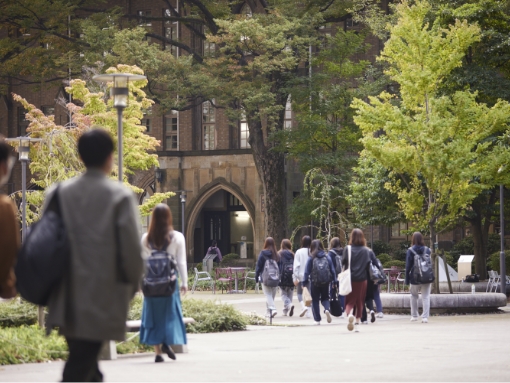
Right in the heart of Tokyo, students can enjoy a peaceful learning environment surrounded by lush greenery.
3.Financial support from Gakushuin
Gakushuin's adequate financial assistance helps exchange students focus on their studies, not disturbed by financial constraints.
4.A wide range of courses taught in English
A wide selection of programs taught in English broaden the opportunities for students' global learning.
Scholarships and Other Financial Support
1.Tuition Waiver
Based on inter-university agreements, tuition fees at Gakushuin University are fully waived.
2.Exchange Student Scholarship
A lump-sum scholarship of up to 60,000 yen is provided for one-semester study, and up to 120,000 yen for one-year study.
3.Housing Subsidy
For students staying in designated housings, a monthly subsidy of up to 50,000 yen is provided.
Other Support
1. Buddy System
Two or three Japanese student buddies are assigned to each exchange student to provide overall support during their stay.
2. Student Assistant (SA) System
Student Assistants (SAs) offer one-on-one support for exchange students' Japanese language learning, under the guidance and advice of the instructors in charge. This program is administered by the Foreign Language Teaching and Research Centre.
3. Writing Support
The Learning Support Center helps exchange students improve their Japanese writing in assignments, reports, and presentation materials by working together with them.
Japanese Language Education at Gakushuin University
Japanese Language Courses
Courses are divided into three levels -- Elementary, Intermediate, and Advanced. With small class sizes, students can improve their Japanese proficiency step by step.
Online Japanese Language Course before Arrival (JLPC)
Gakushuin University offers the Japanese Language Preparatory Course (JLPC), an online Japanese language course provided before arrival for inbound exchange students who have not met the Japanese language requirements for the exchange programs.
English-taught Courses Offered by International Centre
The International Centre offers courses in English that help students deepen their understanding of Japan. Many exchange students take these courses every year.
| Course Name | Content |
| Japan StudiesⅠ:Politics and Public Policy |
This course is one of the four Japan Studies Courses offered by the International Centre. Both Japanese and international students are welcome to take this class.
|
| Japan StudiesⅡ:Japan and the World |
This course examines how Japan makes foreign-policy choices in the contemporary international order. It explores how domestic institutions, historical legacies, and regional and global pressures shape Japan's responses to security challenges, economic competition, and global governance issues.
|
| Japan StudiesⅢ:Contemporary Japan and Society | This course provides an opportunity to observe and analyze people's conduct and/or language usage in contemporary Japanese society. As one approach to examining these issues, you will be introduced to the basics of qualitative research methods, which allows you to see the world surrounding you more critically and deeply. By applying some of these methods, you will design and conduct group research projects to investigate socio-cultural aspects of Japan observed in your everyday life. |
| Japan StudiesⅣ:Art, Culture and Communication | This course aims to explore Japanese everyday interaction from various socio-cultural aspects that may affect speakers' ways of interacting with others. By analysing it in detail, comparing it to practices in other languages, and sharing experiences and opinions with classmates, you will gain more insight into how people select their words and expressions and thereby perform social actions. You will see socio-cultural phenomena of Japanese communication from a wider perspective, while observing and analysing your own language use and its possible impacts on others. |
Messages from Former Exchange Students
FAQ
1.Is it okay if I don't have Japanese language skills?
As a general rule, we require that exchange students have a certain level of Japanese language proficiency. For students who have not taken any Japanese class before but strongly wish to study at Gakushuin University, we offer the Japanese Language Preparatory Course (JLPC) online before they arrive in Japan. Completing this course will fulfill the Japanese language requirement.
2.When and where will exchange students apply for financial assistance?
They will submit an application for financial assistance during the orientation session after arrival in Japan.
3.What happens if a one-year exchange student takes a half-year course?
Credits will not be awarded, but instead, the Evaluation Sheet will be issued to demonstrate the student's performance.
4.Do all faculties and graduate schools offer courses in English?
Besides the Faculty of International Social Sciences, the number of courses taught in English is limited at Gakushuin.
5.Can an exchange student take sport classes or courses offered by other faculties?
With the instructor's permission, an exchange student can take such classes/courses. In fact, many exchange students enroll in these courses every year.
6.Can an exchange student take Japanese-taught courses, regardless of his/her Japanese proficiency?
Japanese-taught courses are specialized, so an N3 or higher JLPT level of proficiency is generally required.
Information Materials for Students Interested in Exchange Programs
We have created promotional materials for students who are considering studying abroad at our university through an exchange agreement.
If you are interested, please feel free to use them as a reference.
Recommend
For Prospective Exchange Students